Finland Guide
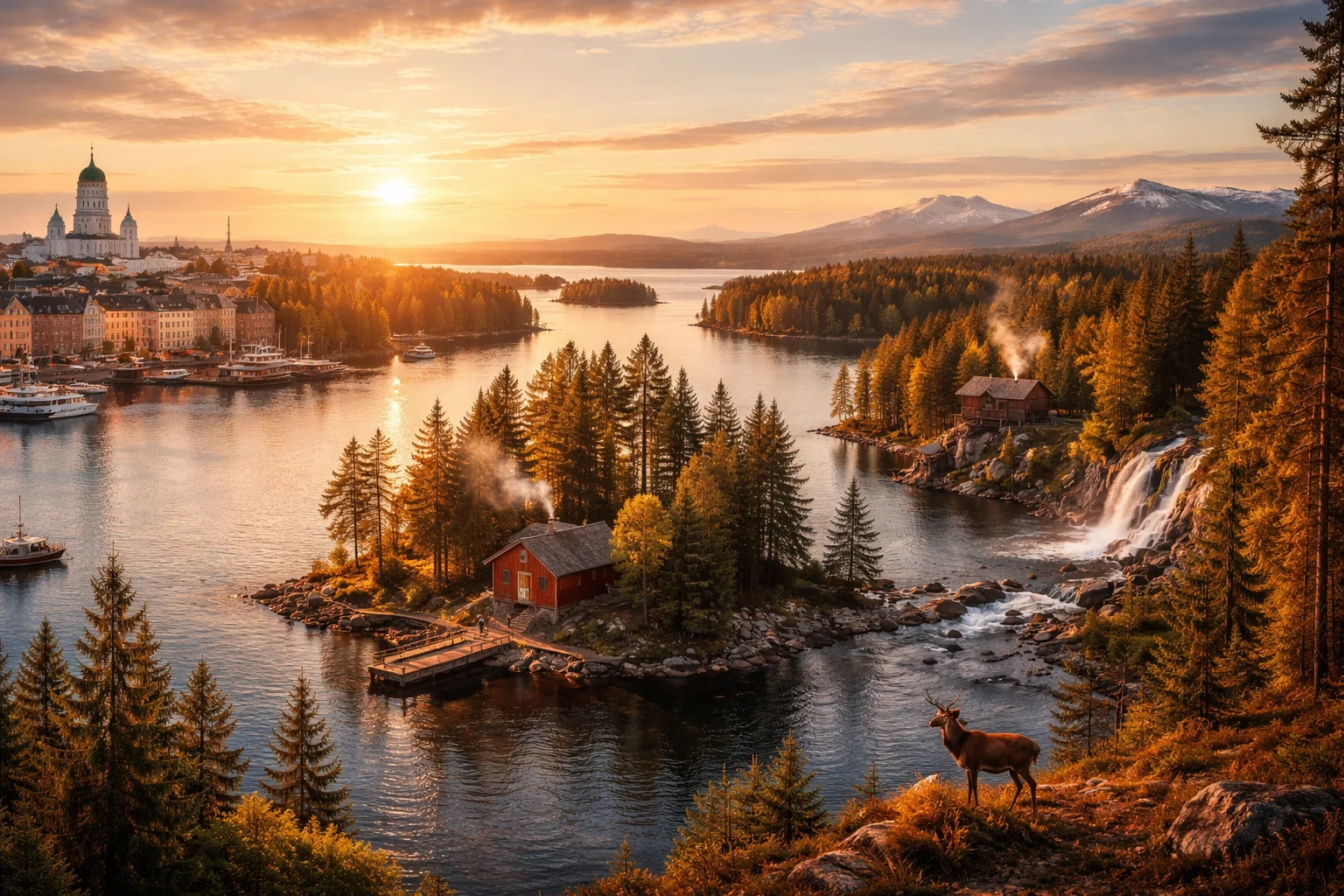
Finland overview
Finland is a Northern European country on the Fennoscandian Peninsula, defined by a cold temperate climate, an industrialized economy, and an Arctic to boreal position that shapes daily life. Its capital is Helsinki, located on the southern coast; the country combines a Nordic welfare-state model with a strong technology sector and a sparse Arctic interior. Finland is notable for having a Uralic national language unrelated to its Indo-European neighbors, a history of rule under both Sweden and Russia, and a governance culture that emphasizes local municipal responsibility.
Common Geography Questions About Finland
Where Finland is located
Finland sits in Northern Europe between 60° and 70° north latitude, occupying the eastern portion of Fennoscandia. It borders Sweden to the west, Norway to the north, and Russia to the east; the Finland–Russia land boundary is one of the longest external borders of the European Union. To the south and southwest Finland fronts the Gulf of Finland and the Gulf of Bothnia, both extensions of the Baltic Sea; the country’s long indented coastline and island-studded archipelago position Finland as a maritime northern state with both Atlantic and Arctic climatic influences.
Geography and landscape of Finland
Finland’s surface is a mosaic of glacially scoured lowlands, lakeland plateaus, and gentle fells in the far north. The country’s defining feature is an extensive lake district and tens of thousands of islands formed by the last Ice Age; eskers and moraine ridges are common inland landforms. Northernmost Finland crosses the Arctic Circle, giving rise to tundra-like fell plateaus and permanent winter conditions above timberline. Peatlands and coniferous forests dominate the midlatitudes, while the southern coastal plain supports the highest population density and the most continuous cultivated land.
Finland culture and society
Finnish culture is anchored by the Finnish language (a Uralic language with vowel harmony and agglutinative grammar) and an official Swedish-language minority; Sámi languages have protected status in northern municipalities. Social customs emphasize privacy, direct communication, and strong civic services delivered by municipalities. A distinctive social practice is the ubiquitous use of saunas as everyday communal and domestic spaces; another is widespread legal access to uncultivated land for recreation (known in Finnish law as an established public right to roam). Religious affiliation historically centers on Lutheran institutions, but social life is shaped more by civic and local networks.
History of Finland
Finland’s historical arc moves from prehistoric hunter–fisher communities through centuries as an eastern borderland of the Swedish kingdom, into a 19th-century Grand Duchy under Imperial Russia, and then independence in 1917. The young republic experienced a brief civil war, negotiated Åland autonomy through international arbitration, and endured defensive wars on the northern frontiers in the 20th century. Postwar decades saw rapid industrialization, urbanization, and the construction of a comprehensive public sector; Finland’s modern identity was forged by balancing Western economic integration with security realities on its eastern flank.
Finland economy and government
Finland is governed as a parliamentary republic with a unicameral legislature (the Eduskunta) and executive powers shared between a president and a prime minister; local government is extensive, with municipalities delivering many public services. The economy combines large, sustainable forest resources and related industries (paper, pulp, wood products) with advanced electronics, software, and cleantech sectors that grew from a late-20th-century technology surge. The country uses the euro as currency and has an export-oriented trade profile; corporate innovation, significant R&D activity, and a tradition of public-private collaboration characterize its economic model.
Regions and major cities of Finland
Administrative organization rests on regional units (maakunnat) and numerous municipalities; a special autonomous region in the Baltic Sea has a Swedish-speaking character and local legislative powers. The capital, Helsinki, anchors the country’s southern urban corridor and serves as the main political and economic hub. Other major cities include Tampere, a historic industrial center now focused on technology and education; Turku, a historic port and cultural gateway; and Oulu, known for its northern high-tech cluster. Northern Lapland is the largest region by area and remains thinly populated with distinct Sámi cultural zones.
Distinctive characteristics of Finland
Finland is associated worldwide with several concrete and verifiable features: its legal “right to roam” allowing recreational access to most uncultivated land; the global footprint of Finnish technology firms and projects (notably the telecommunications rise that centered on companies originating in Finland); cultural exports like the Moomins and notable architects such as Alvar Aalto; and Arctic expertise from Lapland’s reindeer herding and polar research communities. The country’s northern tourism icons include a winter tourism infrastructure built around a named Santa Claus village and services oriented to polar light phenomena and winter logistics.
Places in Finland
Aalto University
Aalto University is a public university located in Finland that combines education and research across technology, business, and design. It was established in 2010 through the formal merger of three predecessor institutions and has since operated from a main campus in Otaniemi, Espoo. Aalto University is organised into multiple constituent schools and professional units, and its institutional mandate emphasises multidisciplinary research and education linking engineering, economics, and the arts. One measurable fact is that the university structure includes distinct schools for engineering, business, and arts and design.
Ateneum
Ateneum is a national art museum in Finland, located in the capital city of Helsinki. It functions as the principal museum within the Finnish National Gallery responsible for the public collection of classical Finnish painting and sculpture. The institution maintains a permanent collection and rotating exhibition spaces housed in a purpose-built museum building that serves as a focal point for scholarship, conservation, and public display of Finland’s historical art holdings.
Design District Helsinki
Design District Helsinki is an urban district in Finland located within central Helsinki. It occupies parts of the Punavuori and Kaartinkaupunki neighbourhoods south and southwest of Helsinki Central Station and is known as a concentrated, branded cluster of design-related shops, studios, galleries and creative businesses recorded in municipal planning references. The district functions as an identifiable economic and cultural area within the City of Helsinki municipal framework. The district name also serves as a local organizing brand for participating enterprises.
Helsinki
Helsinki is Finland's capital and national seat of government. Located on the Gulf of Finland, it is also the country's largest municipality by administrative functions and urban development. Its roughly 715 square kilometres encompass urban districts and numerous maritime islands. National ministries, major research universities, and cultural institutions support Helsinki's wider significance in Finland and northern Europe.
Helsinki Central Station
Helsinki Central Station is the principal railway station in Finland, serving as the city’s main rail terminus and national rail hub. Its role as the core interchange for commuter and long-distance services is administered in practice by the national operator VR Group and coordinated with municipal infrastructure authorities. The station building, designed by architect Eliel Saarinen and manifesting National Romantic influences, stands as a formally recognized urban transport facility located at specific geographic coordinates used in municipal planning and rail operations. The facility contains a large concourse, multiple platform tracks, and integrated underground connections forming a measurable transport node in Helsinki’s network.
Kiasma
Kiasma is a museum of contemporary art in Finland, situated in the capital city of Helsinki. It functions as a national institution for contemporary art within the Finnish National Gallery framework and occupies a purpose-built urban site directly adjacent to the national Parliament complex. The museum is housed in a purpose-designed building by architect Steven Holl, and its institutional role includes maintaining a permanent collection, staging temporary exhibitions, and conducting conservation and research related to contemporary visual art.
Korkeasaari Zoo
Korkeasaari Zoo is a municipal zoological garden in Finland, located on Korkeasaari island within the city of Helsinki. The zoo functions as Helsinki’s principal public zoological institution, occupying an island site with a mixture of purpose-built enclosures and historic animal pavilions and serving as the city-operated collection for managed wildlife, animal care, and education.
Lapland
Lapland is the northernmost and largest region of Finland, defined by expansive sub-Arctic landscapes and a sparse human population. It covers roughly 100,000 square kilometres and contains extensive tracts of boreal forest, fells and freshwater systems, which contribute to its scientific and ecological significance. Lapland is also the traditional homeland of the Sámi people and a focus for research into Arctic environments and northern cultural history. The region’s scale and demographics make it distinct within Finland.
University of Helsinki
University of Helsinki is a public research university in Finland with origins dating to its 1640 founding as the Royal Academy of Turku. It serves as Finland’s oldest university and a major national research institution, maintaining multiple campuses and specialist collections. The institution occupies a central administrative main building on Senate Square in Helsinki and operates distinct faculties and research units that span humanities, natural sciences, medicine, and law. The university is governed by a board and a rector under Finnish higher-education law and bears formal responsibility for large national research collections and academic degree conferrals.