Ethiopia Guide
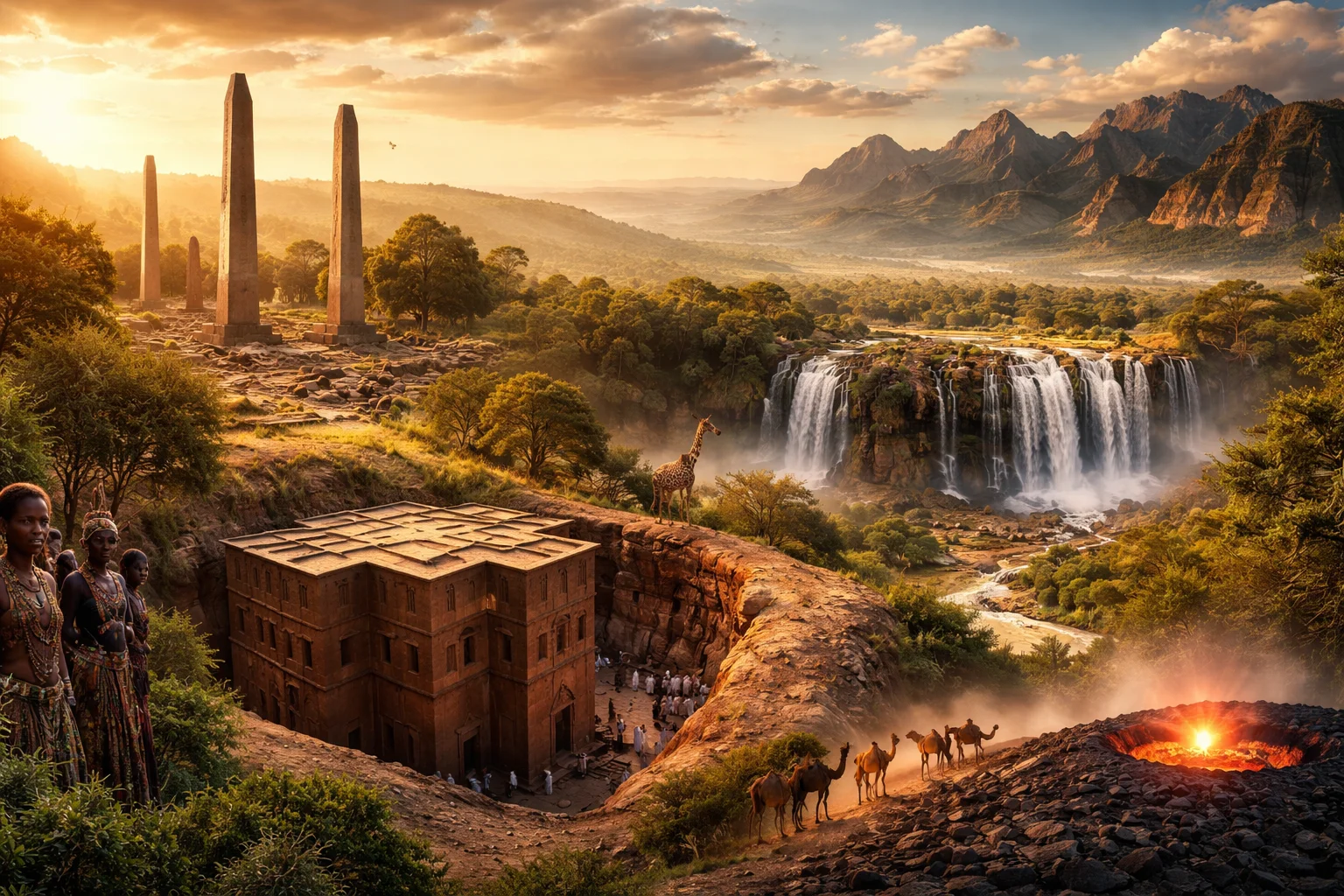
Ethiopia overview
Ethiopia is a federal republic in the Horn of Africa with a long continuous history and a distinctive highland-dominated geography. Straddling the East African Rift, Ethiopia combines upland plateaus that rise above 3,000 meters with desert depressions well below sea level. The country is a cultural crossroads where the Ge'ez script, an ancient Christian tradition, and Cushitic and Semitic languages coexist. Addis Ababa, the administrative center, hosts major regional institutions and serves as an economic and diplomatic hub for the region.
Common Geography Questions About Ethiopia
Where Ethiopia is located
Ethiopia lies in northeastern Africa on the Horn of Africa, roughly between about 3°N and 15°N latitude and 33°E to 48°E longitude. It is bordered clockwise by Eritrea to the north, Djibouti and Somalia to the east, Kenya to the south, and South Sudan and Sudan to the west. Although Ethiopia once had Red Sea coastline, it has been landlocked since the independence of Eritrea; its nearest maritime outlets are the ports of Djibouti and, historically, Massawa. Major inland waters include Lake Tana, the source of the Blue Nile, which helps define Ethiopia’s position within the Nile basin.
Geography and landscape of Ethiopia
The Ethiopian Highlands form the most extensive continuous upland in Africa, punctuated by ranges such as the Simien Mountains and a highest peak, Ras Dashen. The East African Rift slices the country, creating the Great Rift Valley with a chain of crater lakes and the Danakil Depression, one of the planet’s lowest and volcanically active places. Rivers include the Blue Nile (Abbay), which descends from Lake Tana, and the Awash, draining into the Rift lakes. Climatic zones range from humid afro-alpine plateaus to arid lowlands, producing stark regional contrasts in soils and vegetation.
Ethiopia culture and society
Ethiopia’s linguistic landscape centers on Amharic as the federal working language, alongside widely spoken languages such as Oromo, Tigrinya and Somali; the ancient Ge'ez alphabet remains in liturgical use. Religious life is dominated by the Ethiopian Orthodox Tewahedo Church in the highlands and Islam and indigenous faiths in many lowland zones. Daily social rituals include the coffee ceremony, a formalized hospitality practice unique in its regional prominence; among Oromo communities the Gadaa system persists culturally as a traditional generational governance and social organization. Ethnic identity and language strongly shape social institutions.
History of Ethiopia
Ethiopia’s history spans the ancient Aksumite kingdom, a Mediterranean-African trading power that adopted Christianity in the fourth century, through medieval highland polities that claimed Solomonic descent. European contact intensified after the 15th century; in 1896 Ethiopian forces defeated Italy at Adwa, a rare African victory over a colonial power during the Scramble for Africa. The 20th century brought a brief Italian occupation and later revolutionary state transitions culminating in a 1995 constitution that established a federal arrangement. Early paleoanthropological finds in the Rift, including the Hadar discoveries, anchor Ethiopia in studies of human origins.
Ethiopia economy and government
Ethiopia is governed as a federal parliamentary republic composed of ethnically defined regional states; the constitution affords regions broad autonomy and, uniquely among most constitutions, a formal right of self-determination. The executive is headed by a prime minister while the presidency is largely ceremonial. The currency is the Ethiopian birr. The economy remains anchored in agriculture—coffee, livestock and oilseeds—while manufacturing, construction and air transport (notably the state-backed national airline) have been prioritized in development policy. Being landlocked has led Ethiopia to cultivate strong transport and trade links with neighbouring ports.
Regions and major cities of Ethiopia
Administratively, Ethiopia is divided into regional states (kililoch) and chartered cities; notable regions include Oromia, Amhara, Tigray, Somali and the Southern Nations, Nationalities, and Peoples’ Region (SNNPR). The capital, Addis Ababa, serves as the political and diplomatic center. Other principal cities include Dire Dawa, an early colonial-era rail hub; Mekelle, a commercial center in the north; Gondar, known for its imperial-era castles; and Bahir Dar on Lake Tana, which connects urban life with the riverine highlands. Distinct geographic subregions—highlands, Rift Valley, and arid southeastern lowlands—shape regional identities.
Distinctive characteristics of Ethiopia
Ethiopia is widely associated with a set of concrete, recognizable features: the origin of Coffea arabica in the southwestern highlands (the historical region of Kaffa), rock-hewn monolithic churches such as those at Lalibela, and a 13-month local calendar that runs roughly seven to eight years behind the Gregorian count. The Ge'ez script and unique liturgical traditions persist alongside internationally celebrated long-distance runners. Paleoanthropological discoveries like “Lucy,” endemic species such as the Ethiopian wolf, a major pan‑African airline headquartered in Addis Ababa, and the country’s role as a diplomatic center give Ethiopia a distinct global profile.
Places in Ethiopia
Addis Ababa
Addis Ababa is Ethiopia's capital city and the country's primary political and administrative center. It is a national hub for government, diplomacy, and cultural institutions, and it hosts the headquarters of the African Union and several international bodies. Addis Ababa covers approximately 527 square kilometers, including dense urban zones and extensive peri-urban districts.
Addis Ababa Lion Zoo
Addis Ababa Lion Zoo is a zoological facility in Ethiopia that maintains a managed collection of lions and other captive mammals. It is located in the capital city of Addis Ababa and functions as the municipal urban zoo with dedicated lion enclosures and onsite veterinary quarantine facilities. The institution serves a formal role in keeping and caring for Panthera leo specimens within an urban public-science collection, and its compound includes purpose-built holding bays and a small administrative complex.
Addis Ababa University
Addis Ababa University is a public research university in Ethiopia located in the national capital, Addis Ababa. The institution functions as the country’s oldest degree-granting university and a central national research and teaching body, founded as the University College of Addis Ababa and later reconstituted under a university charter. Addis Ababa University operates multiple inner-city campuses and maintains formal research institutes and museum collections that serve as measurable public resources for Ethiopian studies and higher education governance.
Axum Obelisks
Axum Obelisks is a cluster of ancient carved stelae near the city of Axum in northern Ethiopia, representing Aksumite monumental sculpture and funerary practice. The site includes multiple monolithic granite stelae, the largest of which measures about 24 meters in height. Its significance derives from its connection to the Aksumite state, distinctive architectural carving traditions, and its role within a larger archaeological landscape that documents early state formation in the Horn of Africa.
Bale Mountains
Bale Mountains is a highland massif in southeastern Ethiopia, forming a prominent portion of the Ethiopian Highlands. The range includes the Sanetti Plateau and peaks rising to 4,377 meters at Tullu Demtu. It lies within Oromia Region and functions as a major water catchment that feeds the Shebelle River headwaters. Protected tracts include a national park covering roughly 2,200 square kilometers. The massif’s combination of Afro-alpine plateau, montane forest, and endemic fauna underpins its national and international ecological significance.
Blue Nile Falls
Blue Nile Falls is a waterfall on the Blue Nile River in Ethiopia, locally called Tis Issat, meaning "smoking water." It is a major geographic landmark on the upper Nile system and a national symbol of hydrological importance. The fall plunges from a basalt plateau and is commonly described as approximately 45 meters in vertical drop, producing a steep cascade that has attracted scientific, cultural, and infrastructural attention.
Danakil Depression
Danakil Depression is a low-lying tectonic basin in northeastern Ethiopia characterized by active rifting, extensive salt flats, and intense geothermal activity. It occupies parts of the Afar Region and reaches roughly 100 meters below sea level at its lowest points. The area is significant for illustrating continental breakup at a triple junction, for hosting persistent volcanic phenomena such as the Erta Ale lava lake, and for supporting long-standing salt production that shaped regional economies.
Erta Ale Volcano
Erta Ale Volcano is a low-profile basaltic shield volcano in the Afar Region of northeastern Ethiopia, notable for persistent eruptive activity. The summit reaches approximately 613 meters above sea level, a measurable topographic datum within the Afar Depression. Its geological significance arises from emplacement on the East African Rift system, where mantle upwelling and crustal extension sustain volcanic output that has attracted sustained scientific study.
Gondar Castles
Gondar Castles is a complex of royal-era castles and palaces located in the city of Gondar, Ethiopia, noted for its concentrated imperial architecture. The group forms the core of the Fasil Ghebbi royal enclosure and exemplifies Gondarine architecture as a distinct historical style. The complex is inscribed on the UNESCO World Heritage List, a formal recognition that identifies it as a property of outstanding universal value. Gondar Castles therefore combine architectural, historical, and cultural significance.
Harar Jugol
Harar Jugol is a fortified historic town in eastern Ethiopia and the dense core of the city of Harar that preserves an intact medieval urban fabric. It lies within the Harari Region and is notable for continuous occupation and cultural continuity. The walled enclosure is pierced by five principal gates, and the urban compound includes numerous traditional houses, narrow alleys and several historic mosques that embody its measurable architectural integrity.
Lake Tana
Lake Tana is the largest lake in Ethiopia, situated in the Amhara Region of the Ethiopian Highlands and serving as the primary source of the Blue Nile. It covers about 3,673 square kilometres and lies within a broad highland basin. The lake's significance includes its hydrological role for the Nile system and its concentration of medieval monastic sites that preserve illuminated manuscripts and ecclesiastical art, making it both an ecological and cultural landmark.
Lake Tana Monasteries
Lake Tana Monasteries is a collective of Ethiopian Orthodox Christian monasteries and chapels located on islands and peninsulas of Lake Tana in Ethiopia. The complex comprises religious buildings, medieval churches, and manuscript libraries that have influenced regional liturgical traditions. Lake Tana contains approximately 37 islands, several of which host monastic communities and ecclesiastical compounds. The monasteries are significant for their painted icons, illuminated manuscripts, and long-standing role in church administration and regional cultural continuity.