Ecuador Guide
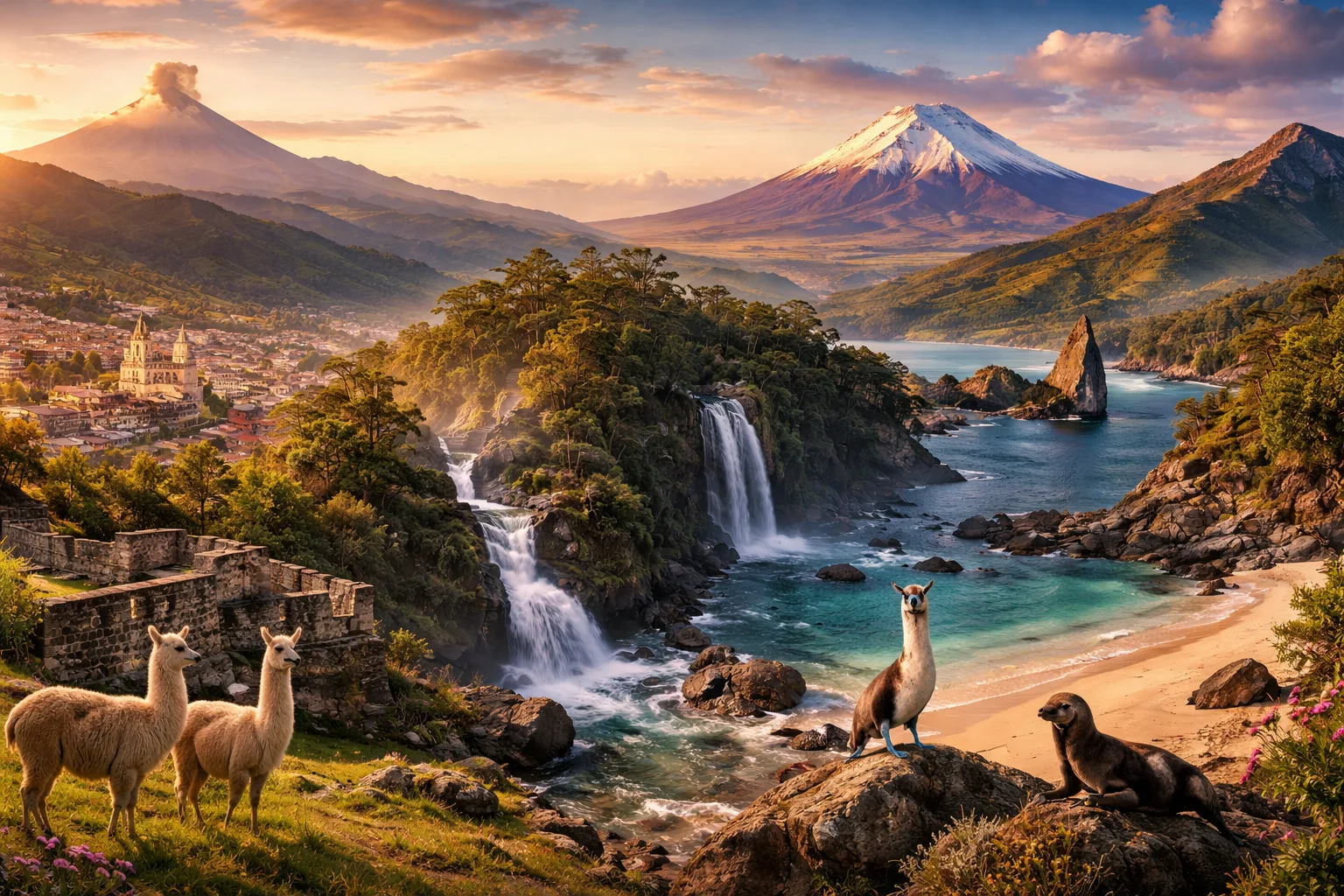
Ecuador overview
Ecuador is a sovereign republic on the northwest coast of South America defined by a sharp vertical profile from Pacific lowlands to Andean peaks. The country’s capital, Quito, sits high in the Andes and is one of the world’s highest national capitals by elevation, shaping transport, architecture and climate across the state. Ecuador’s compact territory concentrates striking ecological and cultural variety into a small area: coastal plains, Andean highlands, extensive Amazon rainforest and an oceanic archipelago. That combination of altitude contrasts and equatorial position has driven much of Ecuador’s national identity and economic specialization.
Common Geography Questions About Ecuador
Where Ecuador is located
Ecuador occupies the northwest corner of the South American continent, directly straddling the equator, and is one of roughly a dozen nations crossed by that latitude line. It borders Colombia to the north and Peru to the east and south, while the Pacific Ocean lies to the west. The country’s sovereign territory also includes an archipelago of volcanic islands nearly 900 kilometres offshore in the Pacific Ocean. Ecuador’s insular and mainland components together define its maritime zones and give the country an unusual mix of continental and oceanic jurisdiction for its land area.
Geography and landscape of Ecuador
Ecuador geography is dominated by a north–south spine of the Andes, which splits the country into distinct landscape bands: the coastal lowlands, the highland sierra, the Amazonian Oriente and offshore islands. A singular geographic fact: the summit of Chimborazo, an Ecuadorian volcano, is the point on Earth’s surface farthest from the planet’s center because of equatorial bulge. Major river systems begin on Andean slopes—the Guayas drains much of the coast while the Napo feeds into the Amazon—while high-altitude páramo ecosystems and tropical rainforest create steep local climatic gradients across short distances.
Ecuador culture and society
Ecuador’s culture blends Indigenous, Spanish colonial and African influences in regionally specific ways; Spanish is the dominant language, while Kichwa and several Amazonian languages remain widely spoken in rural highland and jungle communities. A distinctive cultural export is the toquilla straw hat produced around Montecristi: internationally known as the “Panama hat” despite its Ecuadorian origin. Musical styles such as pasillo and traditional indigenous festivals tied to agricultural cycles persist alongside national Catholic observances, and social life varies sharply between the mestizo-dominated highlands, coastal urban zones, and Amazonian indigenous territories.
History of Ecuador
Ecuadorian history moves from pre-Columbian chiefdoms and later Inca incorporation to Spanish conquest in the 16th century, when Quito became an important administrative and ecclesiastical center. Indigenous resistance and colonial integration produced a distinct regional identity that helped drive independence movements. Independence from Spain was consolidated in the early 19th century after the Battle of Pichincha and a period as part of Gran Colombia; Ecuador emerged as a separate republic in 1830. Subsequent national development involved contestation over regional power between coast and highlands, and the discovery of petroleum in Amazonia reshaped the modern economy.
Ecuador economy and government
Ecuador is a unitary presidential republic with a single-chamber National Assembly as its national legislature; executive power rests with an elected president. Economically, Ecuador has a mixed export base: hydrocarbons from Amazonian fields, agricultural commodities—especially bananas, shrimp and specialty cacao—and a significant floriculture sector for international markets. A distinctive economic policy decision in recent decades was dollarization: Ecuador uses the U.S. dollar as its official currency, which has influenced monetary policy, inflation dynamics and trade patterns. Public institutions and provincial administrations guide resource allocation across diverse regions.
Regions and major cities of Ecuador
Ecuador is administratively divided into 24 provinces that reflect geographic and cultural regions: Costa (coast), Sierra (highlands), Oriente (Amazon) and Insular (Galápagos). The capital, Quito, functions as the political and historical center; Guayaquil is the country’s largest city and principal seaport, and Cuenca is renowned for its preserved colonial center and cultural institutions. Each of these Ecuador major cities plays a different role: Quito in governance and heritage, Guayaquil in commerce and logistics, Cuenca in regional services and tourism, illustrating how urban functions map onto the country’s varied landscapes.
Distinctive characteristics of Ecuador
Ecuador is globally associated with a handful of precise features: its role as the origin of the equator’s national identity and of the Mitad del Mundo monument; internationally traded products such as fine-flavor “Arriba” cacao, cut flowers and a top-ranking banana export sector; and unique conservation sites like Yasuni’s hyperdiverse Amazonian forests. It also holds two UNESCO-recognized cultural and natural heritages in its national profile. These concrete linkages—to a geographic line, specific agro-exports and notable conservation areas—are how Ecuador is most often recognized on the world stage.
Places in Ecuador
Central University of Ecuador
Central University of Ecuador is a public national university in Ecuador. It is based in the capital city of Quito and was founded in 1826 as a state institution that established higher education under the early republic. The Central University of Ecuador holds formal status as a public autonomous university under Ecuadorian law and serves as a core provider of professional education, research, and public-service functions for the country. The university maintains a central campus and associated academic units within Quito.
Cotopaxi National Park
Cotopaxi National Park is a national park in Ecuador that protects the Cotopaxi stratovolcano and adjacent highland ecosystems. It contains the glaciated Cotopaxi summit, which rises to 5,897 meters above sea level, and encompasses upper Andean landscapes managed for conservation. The park is significant for its role in preserving high-altitude páramo, protecting headwaters that supply downstream basins, and serving as a subject for volcanological and ecological study.
Galápagos Islands
Galápagos Islands is an archipelago of volcanic islands in the eastern Pacific belonging to Ecuador and noted for its biological importance. The island group comprises 18 main islands, three smaller islands, and more than 100 islets and rocks, with a land area of about 7,880 square kilometres. Its significance arises from exceptionally high rates of endemism and distinct island ecosystems that have shaped scientific research, conservation practice, and global understanding of species adaptation and biogeography.
Galapagos National Park
Galapagos National Park is a national park of Ecuador that protects the terrestrial environments of the Galápagos Archipelago. It is the principal state-designated protected area for the islands, conserving the land portions of most major islands in the eastern Pacific. The park is significant for its formally established role in preserving high levels of endemism, for its association with foundational scientific study, and for its institutional management within Ecuadorian conservation law.
La Ronda
La Ronda is a historic district in Quito, Ecuador. It is located within the core of Quito’s colonial Historic Center, a formally designated UNESCO World Heritage area, and consists principally of a narrow, contiguous street corridor lined with colonial-era houses. The district functions as a conserved fragment of Quito’s colonial urban fabric, retaining original plot alignments and built frontages. Its significance rests on formal heritage status, a continuous built form, and an established role in the city’s cultural conservation programs.
Quito
Quito is the capital city of Ecuador, situated in the central Andes and functioning as the national political center. The city stands at approximately 2,850 meters above sea level, a formally measured elevation. Quito serves as the administrative seat for national government institutions and provincial authorities. Its historic urban core contains extensive colonial architecture and dense urban fabric that contribute to its long-term cultural and civic significance.
Quito Zoo
Quito Zoo is a municipal zoological park in Ecuador located in the Guayllabamba parish of the Quito Metropolitan District. It functions as the city’s principal curated collection for regional fauna and as a public conservation institution administered within Quito’s municipal framework. The site occupies grounds within the Guayllabamba valley and organizes exhibits to represent Ecuadorian bioregions, providing a defined institutional role in city-level wildlife stewardship.
Explore Natural Landmarks in Ecuador
Browse islands and mountains connected with Ecuador to keep exploring related geography clusters.