Denmark Guide
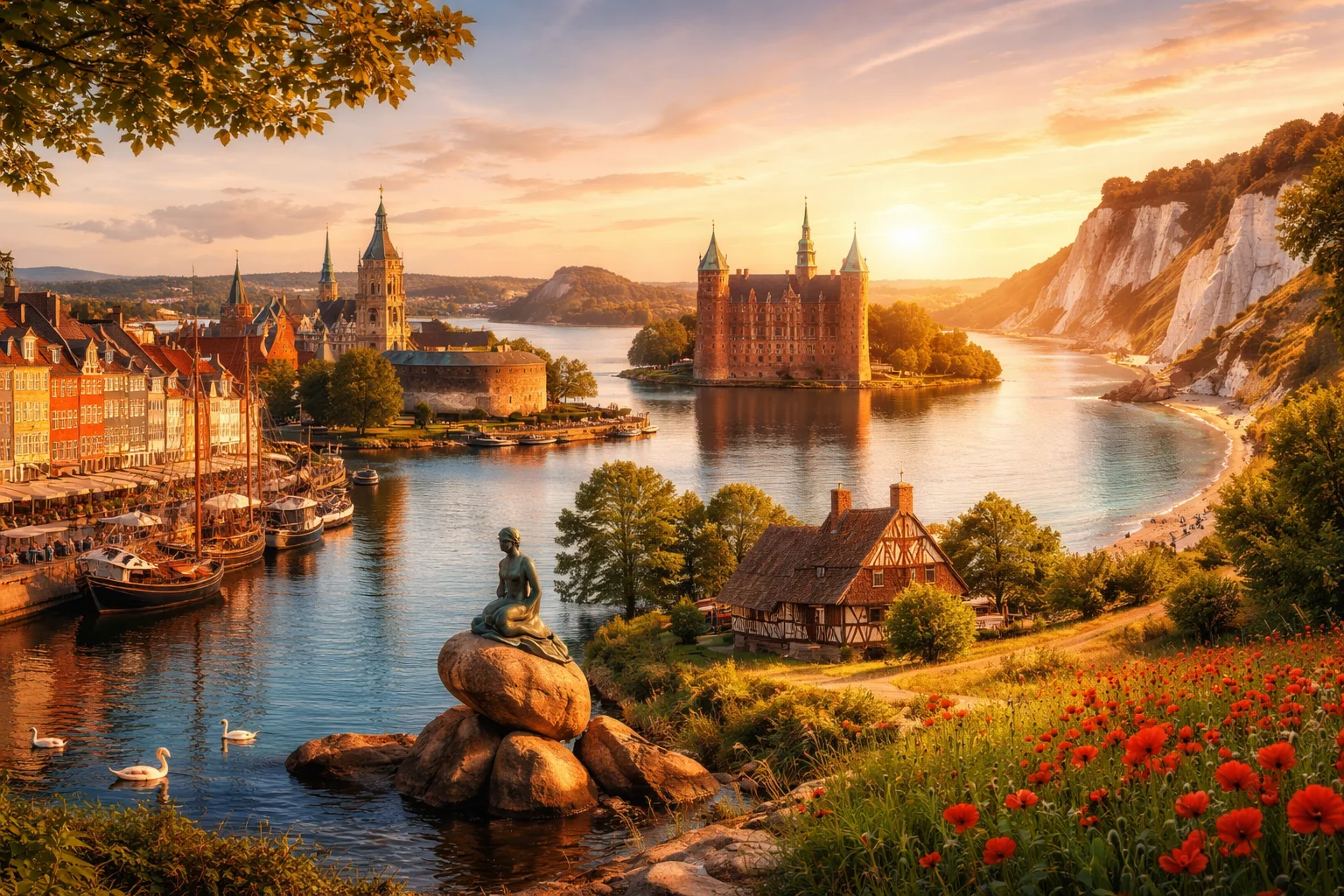
Denmark overview
Denmark is a Nordic kingdom in Northern Europe consisting of a compact mainland peninsula and more than four hundred islands, with two autonomous territories in the North Atlantic. The country combines a long maritime orientation with a parliamentary constitutional monarchy and an extensive welfare state model that evolved in the 19th and 20th centuries. Denmark’s economy mixes advanced manufacturing, global shipping and renewable-energy technology, while its political structure links Copenhagen to autonomous administrations in Greenland and the Faroe Islands. Its small land area contrasts with outsized cultural and commercial reach.
Common Geography Questions About Denmark
Where Denmark is located
Denmark sits at the northern edge of continental Europe, occupying the Jutland peninsula and an archipelago between about 54°–58°N and 8°–15°E. It borders Germany by land on Jutland and shares maritime borders across the Skagerrak, Kattegat and the Øresund with Norway and Sweden; the country faces the North Sea and the Baltic Sea. Unusually, Denmark comprises roughly 406 named islands—around seventy of which are inhabited—so its geopolitical footprint is defined as much by sea lanes and straits as by contiguous territory.
Geography and landscape of Denmark
The Danish landscape is predominantly low-lying and glacially formed: rolling moraines, heathland, reclaimed coastal plains and shallow fjords. There are no high mountain ranges; Denmark’s highest natural point is Møllehøj at about 171 metres, a fact that frames agricultural land use rather than upland pastoralism. The longest river, the Gudenå, threads Jutland’s inland lakes, while distinctive chalk cliffs such as Møns Klint rise abruptly from the Baltic. Coastal variation—from sandy barrier beaches to steep cliffs—and extensive shoreline shape settlement, fisheries and coastal engineering practices unique to Denmark.
Denmark culture and society
Danish is the national language; in the wider Kingdom, Faroese and Greenlandic are official in their territories, while a recognized German minority persists in southern Jutland. Social institutions distinctive to Denmark include the folk high-school movement (folkehøjskole), which pioneered adult civic education, and a naming law that regulates given names. The Evangelical Lutheran Church of Denmark retains a formal state role uncommon elsewhere. Urban concentration around Copenhagen and a long-standing bicycle commuter culture influence daily life, while social policy and high baseline public services shape demographic patterns across regions.
History of Denmark
Denmark’s state formation traces from Viking-era polities consolidated under figures such as Harald Bluetooth, through Christianization and participation in the medieval Kalmar Union with Norway and Sweden. Maritime trade and overseas colonial activity expanded Danish influence from the Baltic to the Atlantic; the kingdom later ceded Norway and adjusted to 19th-century nation-state pressures, most notably after the 1864 Schleswig defeats. A constitutional monarchy replaced absolute rule in 1849, and Denmark’s 20th-century trajectory moved toward broad social reforms and participation in European security arrangements, while gradually granting autonomy to Greenland and the Faroe Islands.
Denmark economy and government
Denmark is a unitary state with a constitutional monarch and a unicameral parliament, the Folketing; municipal and regional governments handle local services after a nationwide reform that streamlined subnational units. The Kingdom also includes Greenland and the Faroe Islands with extensive home-rule arrangements. The economy is mixed and export-oriented: leading sectors include shipping (A.P. Moller‑Maersk), pharmaceuticals (notably companies originating in Denmark), renewable energy technology (wind-turbine manufacturers), and high-value agriculture. The national currency is the Danish krone, and Denmark has maintained a monetary arrangement that keeps the krone outside the eurozone framework.
Regions and major cities of Denmark
Administratively Denmark is divided into five regions responsible for health and regional planning, and a set of municipalities created in the 2007 reform to deliver local government services; the municipal map concentrates population in urban corridors. Copenhagen, the capital on the island of Zealand close to the Øresund, is the political and economic center. Aarhus in Jutland and Odense on Funen are major urban hubs—Odense is notable as the birthplace of Hans Christian Andersen—while Bornholm in the Baltic and the autonomous Faroe Islands and Greenland underscore the kingdom’s geographic diversity.
Distinctive characteristics of Denmark
Denmark is globally identified with a few concrete achievements: the Dannebrog, its national flag, is cited among the world’s oldest continuously used national flags; Danish companies have shaped global shipping and logistics, notably through A.P. Moller‑Maersk. The country is a leading exporter of wind-technology components and home to major turbine manufacturers, and Danish design and architecture—from Arne Jacobsen furniture to contemporary urban planning—have an outsized cultural footprint. Its historical Viking legacy, the folkehøjskole educational model and well-documented bicycle-first urban policies further distinguish Denmark internationally.
Places in Denmark
Aalborg Zoo
Aalborg Zoo is a zoological garden in Denmark located in the city of Aalborg. It sits within Aalborg Municipality in the North Jutland Region and functions as the city’s principal public zoological collection, presenting a curated assembly of mammals, birds, reptiles and amphibians across purpose-built enclosures and indoor houses managed under Danish regulatory frameworks.
Aarhus University
Aarhus University is a public research university in Denmark with a core campus and multiple city-based facilities serving teaching and research. The institution was founded in 1928 and is governed as a state-recognized university under Danish higher education law. Aarhus University comprises a range of faculties including arts, natural sciences, health, and business-related disciplines, and it operates an integrated library and research infrastructure that supports laboratory science, humanities collections, and clinical partnerships. The university is a major regional research and education centre with formal institutional status and a sustained presence in international rankings.
Copenhagen
Copenhagen is in Denmark. It is Denmark's capital and largest city, serving as the country's political and cultural centre. Copenhagen occupies a compact urban footprint with a municipal area of about 88 square kilometres and functions as the national seat of government and monarchy. Its significance stems from its historical role as a Baltic trading hub, its concentration of national institutions, and its influence on Scandinavian architecture, design, and higher education.
Copenhagen Airport
Copenhagen Airport is an international airport in Denmark with the IATA code CPH and the ICAO code EKCH. It serves as the principal international gateway for the Copenhagen metropolitan area and functions as a central node in Danish civil aviation networks. The airport handles passenger, cargo and airline base activities under a corporate operating structure and provides infrastructure used for scheduled international and domestic air services. This formal designation and operating role define its national transport significance.
Copenhagen Zoo
Copenhagen Zoo is a zoological garden in Denmark located within the urban area of Copenhagen. It sits in the Frederiksberg district and is positioned at approximately 55.67° N, 12.52° E, a measurable geographic reference for the site. The institution functions as an organized animal collection and conservation-oriented facility, combining historical enclosures with later exhibit interventions. The site serves a defined role in captive animal management, record-keeping and collaborative research among Scandinavian zoological organizations.
Freetown Christiania
Freetown Christiania is a self-declared autonomous district within the municipality of Copenhagen, Denmark. It occupies roughly 34 hectares in the Christianshavn area along Copenhagen’s inner harbour and is significant as a sustained urban experiment in alternative governance and collective land use. The settlement’s formal status combines informal resident control with a history of negotiated legal arrangements with municipal authorities. The article focuses on location, history, significance, and physical features.
Louisiana Museum of Modern Art
Louisiana Museum of Modern Art is a museum in Denmark that presents modern and contemporary visual art. The institution sits in Humlebæk on the Danish coast and comprises indoor exhibition galleries together with an adjacent sculpture park as a formal part of its site. The museum operates as an organized art institution with a permanent collection, rotating special exhibitions, and an institutional role in collecting and conserving modern art for public research and study.
National Gallery of Denmark
National Gallery of Denmark is Denmark's national art museum and the principal state institution for the country's public fine-art collection. The museum stands in central Copenhagen and functions as the official repository for Danish and international paintings, sculpture, prints, and works on paper, operating under state cultural authorities and maintaining curatorial, conservation, and research responsibilities for the national collection. The institution occupies a historic main building supplemented by a substantial contemporary wing that increases gallery space.
Norrebro
Norrebro is a district of Copenhagen, Denmark, formally designated as a bydel within Copenhagen Municipality. The district occupies the inner-northern band of the city and includes the arterial street Nørrebrogade and the urban green burial ground Assistens Cemetery. It exhibits a continuous mixed-use urban fabric of residential blocks and commercial frontages that reflects successive phases of civic and industrial development. Norrebro's formal municipal status and its combination of major public spaces make it significant for Copenhagen's urban governance and planning.
Ny Carlsberg Glyptotek
Ny Carlsberg Glyptotek is a museum in Denmark that presents a combined collection of ancient and modern art. It occupies a prominent site on Dantes Plads in central Copenhagen, adjacent to Tivoli Gardens and the City Hall complex, defining its urban location and institutional role. The museum originated from the private collection assembled by brewer Carl Jacobsen and retains that founder connection as a formal part of its identity and governance.
Nyhavn
Nyhavn is a 17th-century canal and historic waterfront district in central Copenhagen. Excavated to connect the inner city with the sea for maritime commerce, it is now defined by narrow quays, colorful townhouses, former commercial buildings, and preserved elements of its working harbour.
Odense Zoo
Odense Zoo is a zoological garden in Denmark located in the city of Odense on the island of Funen. The site functions as a regulated zoological institution with a curated living collection and plays a regional role in animal husbandry, education, and conservation practice. Its grounds occupy landscaped urban parkland within Odense municipality and the site includes purpose-built enclosures and public-facing animal care facilities. This formal status distinguishes Odense Zoo among Danish zoological collections.
Explore Natural Landmarks in Denmark
Browse islands and mountains connected with Denmark to keep exploring related geography clusters.