Croatia Guide
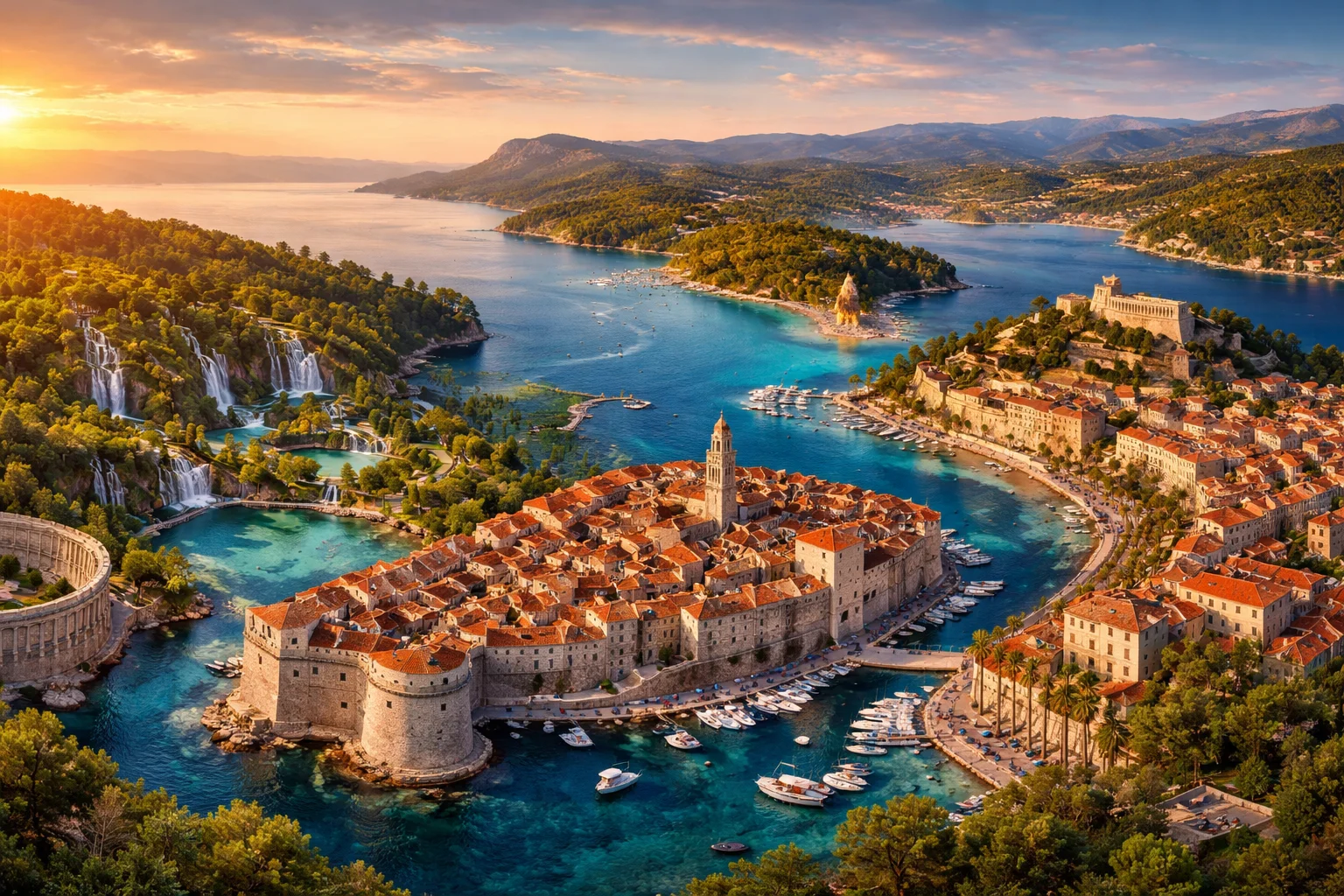
Croatia overview
Croatia is a sovereign state in southeastern Europe characterized by a narrow coastal belt on the Adriatic Sea and interior lowlands that open into the Pannonian Basin. The country combines Mediterranean maritime traditions with Central European administrative and infrastructural patterns, creating a compact but regionally varied profile. Zagreb serves as the political and economic center while coastal cities anchor maritime trade and tourism. Distinctive features include a coastline that is geopolitically split by a small Bosnian corridor and an enduring set of medieval urban centers that remained independent maritime republics into the early modern era.
Common Geography Questions About Croatia
Where Croatia is located
The geography of Croatia spans southeastern Europe at the junction of Central Europe, the Balkans and the Mediterranean. Croatia has a narrow Adriatic coastal belt and interior lowlands opening into the Pannonian Basin, roughly between latitudes 42° and 47° N. It borders Slovenia to the northwest, Hungary to the northeast, Serbia to the east, Bosnia and Herzegovina to the southeast, and Montenegro at a short southern land frontier; Italy lies across the Adriatic to the west. Bosnia and Herzegovina’s tiny Adriatic outlet at Neum interrupts Croatia’s coastline, creating a non-contiguous coastal stretch that separates Dubrovnik from much of the northern coast.
Geography and landscape of Croatia
Croatia’s terrain ranges from the karst limestone Dinaric Alps along the coast to the flat, fertile plains of Slavonia in the east. The Dinaric chain produces rugged peaks such as Dinara and a wealth of karst features—sinkholes, caves and disappearing rivers—that are more pervasive here than in most neighboring states. Inland river systems, especially the Sava and Drava, feed the Danube basin; the Neretva forms a notable delta in the south. Climatic zones shift rapidly: Mediterranean conditions on the Adriatic islands transition to continental winters on the Pannonian plain within short distances.
Croatia culture and society
Croatian is the official language, but the country’s social fabric includes recognized minority languages—Italian, Hungarian and Serbian—in specific localities. Roman Catholicism is the majority religion and shapes many public holidays and rituals, yet glagolitic liturgical fragments and certain island parishes retain a historic Slavic liturgical tradition uncommon elsewhere. Vocal polyphony known as klapa and regional string traditions like the tamburica coexist with a strong island boatbuilding culture and localized culinary specialties such as Istrian truffles and Pag cheese, reflecting both Adriatic and continental influences.
History of Croatia
Croatian history blends early medieval statehood, maritime commerce and imperial entanglements. Medieval Croatian rulers established institutions that later evolved into a parliamentary Sabor; coastal cities like Dubrovnik (the Republic of Ragusa) sustained independent merchant republic models and complex diplomacy with the Ottoman and Venetian powers. Over centuries Croatia oscillated between Hungarian, Habsburg and Ottoman spheres before becoming part of 20th-century Yugoslavia; the dissolution of that federation produced a modern sovereign state whose formation reshaped political borders in the region. These layered legacies explain Croatia’s mixed legal, architectural and social inheritance.
Croatia economy and government
Croatia is a parliamentary republic with an elected president as head of state and a prime minister who leads a multi-party government; a single-chamber Sabor (parliament) handles legislation, and a Constitutional Court reviews legal disputes. The economy balances coastal tourism and maritime services with inland agriculture and industry: shipbuilding and food processing remain long-standing sectors, while precision manufacturing and automotive-supply firms have developed notable export niches. The euro serves as the official currency, integrating Croatia into broader European payment systems and influencing fiscal and monetary policy choices in the national economy.
Regions and major cities of Croatia
Administratively Croatia is divided into twenty counties plus the City of Zagreb with special status; cultural regions include Istria, Dalmatia and Slavonia, each with distinct dialects and land use patterns. Zagreb is the capital and primary urban hub; Split anchors central Dalmatia around the Roman-era Diocletian’s Palace; Rijeka functions as the largest port and an industrial node; Osijek is the principal center of eastern Slavonia’s agricultural plain. Regional governance and bilingual provisions in places like coastal Istria—where Italian has official status alongside Croatian—are specific regional arrangements.
Distinctive characteristics of Croatia
Several concrete traits link Croatia to global recognition: the necktie (cravat) traces its name and origin to 17th‑century Croatian soldiers and merchants; Plitvice Lakes’ natural travertine barriers exemplify karst-driven tufa formation; the Dalmatian dog breed originated in the coastal region now called Dalmatia. Croatia also has a visible presence in niche high-technology automotive suppliers and in cultural outlets—UNESCO-recognized klapa singing and multiple World Heritage urban sites—that together create a mix of natural, historical and technological profiles associated uniquely with the country.
Places in Croatia
Dubrovnik
Dubrovnik is a coastal city in southern Croatia on the Adriatic Sea, noted for a well-preserved medieval old town and extensive fortifications. It functions as an urban and cultural center for its coastal region and retains an old town enclosed by stone walls that form a continuous circuit measuring approximately 1.9 kilometers in length. Dubrovnik's significance derives from its concentrated architectural heritage and long maritime history that shaped Dalmatian coastal development.
Gornji Grad
Gornji Grad is the historic Upper Town district of Zagreb, Croatia. It occupies the hilltop core of central Zagreb and functions as a formal administrative district containing national institutions clustered around St. Mark's Square. The district is defined by a preserved medieval street pattern, surviving fortification elements, and the concentration of parliamentary and government buildings within a compact civic ensemble. This urban core plays a central role in Croatia’s civic-history and municipal identity.
Museum of Broken Relationships
Museum of Broken Relationships is a museum in Croatia that collects personal objects and written testimonies linked to ended relationships. The museum is located in the city of Zagreb and maintains a permanent exhibition space where each donated object is displayed alongside an accompanying personal narrative in a publicly accessible catalog. The institution frames private material culture as a form of social archive, giving concrete form to emotional histories through object-based storytelling.
Old Town Dubrovnik
Old Town Dubrovnik is the historic, walled core of the city of Dubrovnik on Croatia’s Adriatic coast, noted for its intact fortifications and urban fabric. It functions as the preserved medieval centre around a compact street grid and monumental civic buildings. The main defensive walls surrounding Old Town Dubrovnik extend approximately 1,940 metres in continuous ramparts. Its location, discernible building materials, and conserved street plan together demonstrate the site’s history and cultural significance.
Plitvice Lakes National Park
Plitvice Lakes National Park is a protected national park in central Croatia, celebrated for waterfalls and travertine lakes. The park covers approximately 296.85 square kilometres, making it one of Croatia’s largest protected areas. Plitvice Lakes National Park is significant for its striking karst hydrology and long-term scientific study of tufa formation. Its combination of cascading water bodies and forested catchments defines the park’s primary natural value and international recognition.
Plitvice Lakes National Park
Plitvice Lakes National Park is a protected national park in Croatia. It holds international recognition as a UNESCO World Heritage Site and is managed under Croatia’s national system of protected areas. The park is significant for preserving a linked freshwater system and karst landscape that illustrate active geological processes. Formal protection and international listing underline the site's importance for geomorphology and long-term nature conservation.
University of Zagreb
University of Zagreb is a public research university in the Republic of Croatia and the country’s principal higher-education institution. The university is Croatia’s largest by student enrolment and academic scope, operating a multi-faculty system across the city of Zagreb. Its formal identity includes a central rectorate and autonomous constituent faculties and academies that confer undergraduate, graduate, and doctoral degrees within Croatian higher-education law. The University of Zagreb functions as a national academic hub for professional education, basic and applied research, and stewardship of several scholarly collections and scientific facilities tied to the city’s cultural infrastructure.
Zagreb
Zagreb is the capital and largest city of Croatia, positioned in the northwestern part of the country. It functions as the principal political, academic, and cultural centre and has a city proper population of approximately 800,000 inhabitants. The city's significance derives from its concentration of national institutions, extensive historical urban core, and role as an economic hub for inland Croatia. Zagreb holds municipal authority with administrative responsibilities equivalent to a county-level unit within the national governance structure.
Zagreb Zoo
Zagreb Zoo is a municipal zoological garden in Zagreb, Croatia. It is located within Maksimir Park and is the city’s principal managed zoological collection under municipal stewardship. The site occupies parkland carved into wooded slopes and exhibits a range of captive-breeding, educational, and species-maintenance functions typical of an urban scientific collection. The zoo’s identity is tied to its placement inside a major urban park and its role as the primary public zoo in the city.
Zlatni Rat
Zlatni Rat is a pebble spit beach on the southern coast of the island of Brač in Croatia. It lies at approximately 43.26°N, 16.65°E, projecting from the mainland of Brač into the Adriatic Sea near the town of Bol. The feature is notable for its recurved horn shape, its clearly defined narrow neck connecting to the island, and its status as a locally prominent geomorphological landmark documented in coastal studies.