China Guide
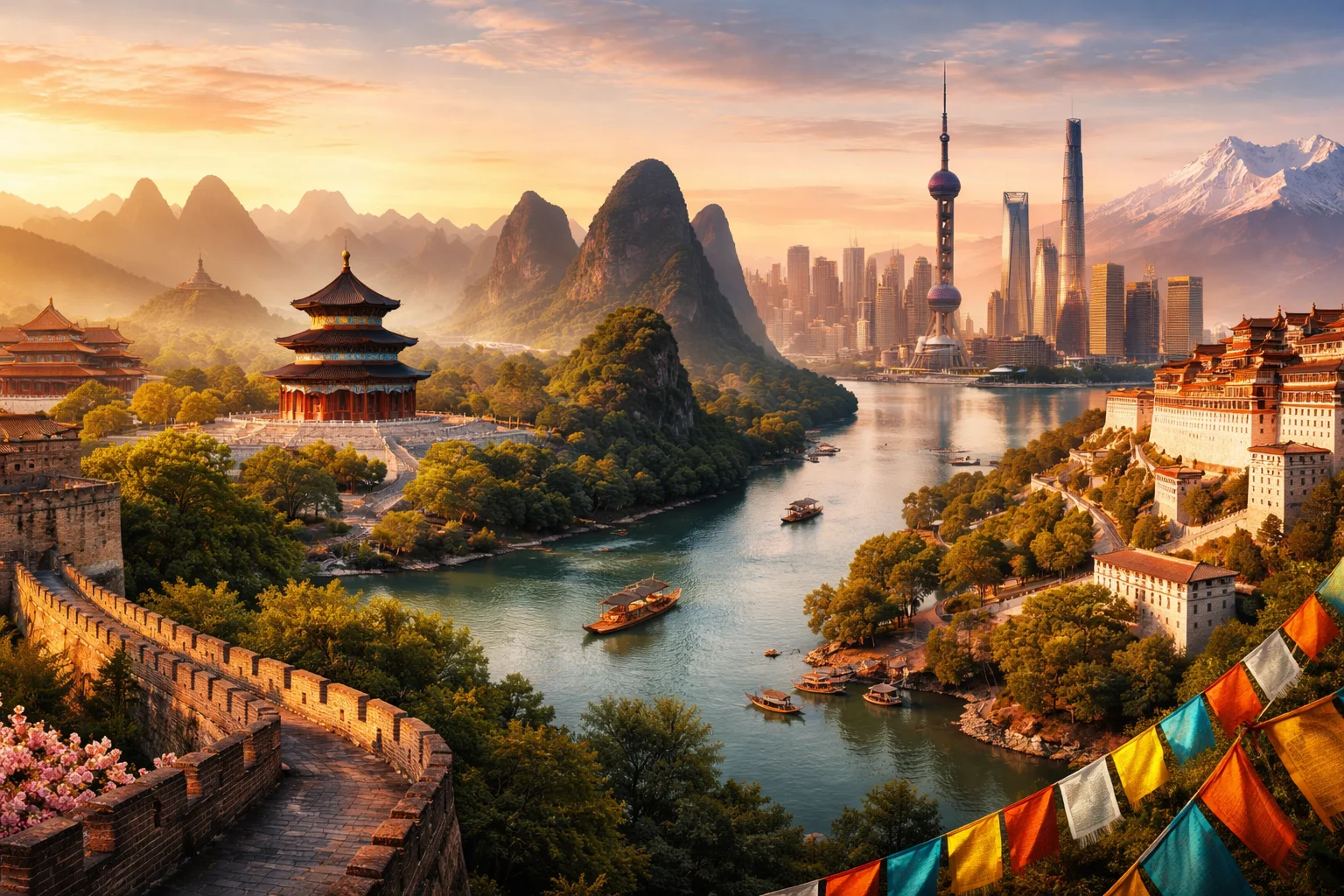
China overview
China is a sovereign state in East Asia with a land area among the world’s largest and a civilization whose recorded history spans millennia. Straddling temperate, tropical and high-altitude zones, China combines dense urban corridors with vast interior plateaus and deserts. Its political system centralizes authority at the national level while a mix of state and private enterprises drive an export-oriented economy. Unique traits include a continuous written tradition and the official use of a single standard time (Beijing Time) across several geographic time zones despite vast territorial span.
Common Geography Questions About China
Where China is located
Located on the eastern edge of the Eurasian landmass, China sits in East Asia roughly between 18°N and 53°N latitude and 73°E to 135°E longitude. It shares land borders with 14 countries — for example, India, Russia, Mongolia, and Vietnam — and meets the Yellow, East China and South China Seas along its eastern coastline. The country’s placement bridges the Eurasian interior and Pacific Rim trade routes, and the geographic position of the Tibetan Plateau and the North China Plain helps define regional climate and river drainage patterns unique to China’s role in Asia.
Geography and landscape of China
China’s terrain ranges from the high Tibetan Plateau—often called the “roof of the world”—to mountain chains like the Himalayas, Tianshan and Qinling that form clear climatic and cultural divides. Major rivers include the Yangtze (Asia’s longest) and the Yellow River, whose loess-fed basin shaped early agrarian civilizations. The country contains the Gobi Desert, extensive karst landscapes in Guangxi, and the fertile deltas of the Yangtze and Pearl rivers. Elevation changes are dramatic: western provinces average far higher altitude than eastern coastal plains, producing sharply different agriculture and settlement patterns across China.
China culture and society
China’s linguistic map centers on Standard Mandarin but encompasses Sinitic varieties such as Cantonese, Wu and Min alongside non-Sinitic languages like Tibetan, Uyghur and Mongolian. Social customs emphasize family lineage and local ritual, and the hukou household registration system ties access to services to place of registration—an administrative feature distinct to China. State-recognized ethnic groups (including a Han majority and multiple minorities) coexist under policies that affect language use and education. Calligraphic writing and the retention of Chinese characters as a primary script are cultural continuities that distinguish China from most modern nation-states.
History of China
China’s history is marked by cycles of dynastic consolidation and fragmentation, beginning with early bronze-age states and crystallizing in imperial unification under Qin in 221 BCE. Over centuries, bureaucratic institutions such as the civil service examination linked meritocratic selection to governance in ways rare elsewhere. Maritime expeditions during the Ming, the northward Mongol conquests, and long inland trade along Silk Road corridors each rewired regional connections. In the 19th and early 20th centuries interactions with industrializing powers and internal reform movements reshaped sovereignty and social order, culminating in the republican era and a mid-20th-century redistribution of political authority.
China economy and government
China is governed as a unitary state led by a single party which exercises centralized authority through provinces, autonomous regions and centrally administered municipalities. Economically, China combines large state-owned enterprises with a dynamic private sector; its industrial base emphasizes manufacturing—steel, electronics and shipbuilding—alongside rapid expansion in information technology and renewable energy manufacturing. The national currency is the renminbi (yuan). Distinctive economic structures include special economic zones created to manage foreign investment and an infrastructure footprint, such as the world’s largest high-speed rail network, that supports internal market integration.
Regions and major cities of China
Administratively, China is divided into provinces, autonomous regions, municipalities with provincial rank and two special administrative regions. The capital is Beijing; other major cities include Shanghai, Shenzhen and Guangzhou, which anchor major cities-based economic corridors. Geographic and cultural regions range from the industrialized Yangtze River Delta and Pearl River Delta to the agricultural North China Plain, the inland Sichuan Basin and the high-altitude Tibetan and Xinjiang regions. Special administrative arrangements — such as “one country, two systems” applying to Hong Kong and Macau — are an uncommon governance feature tied to China’s modern territorial configuration.
Distinctive characteristics of China
China is widely associated with specific, verifiable contributions: the invention and spread of paper, printing, the compass and gunpowder; centuries-long silk and porcelain trade; and contemporary prominence in global manufacturing and solar-panel production. It has a recognizable profile in infrastructure—extensive high-speed rail and major port hubs—and in control of much of the world’s rare-earth processing capacity. Linguistically and culturally, mainland China’s use of simplified characters contrasts with traditional characters used elsewhere; gastronomic diversity, regional operas and Chinese calligraphy remain internationally identified hallmarks linked to China’s longstanding global influence.
Places in China
798 Art District
798 Art District is an urban contemporary art district in Beijing, China. It occupies a repurposed industrial complex in the Dashanzi area of Chaoyang District, and its location is commonly identified near coordinates 39.985°N, 116.502°E. The district is significant for its concentration of galleries, artist studios, and cultural organizations housed within former state-owned factory buildings, and for its role in Beijing’s post-industrial cultural transformation.
Beijing
Beijing is the capital city and a direct-administered municipality of the People's Republic of China, serving as the national political center. The municipality covers about 16,410 square kilometers and contains multiple urban, suburban, and rural districts under unified municipal government. Beijing holds national significance for governance, culture, and international diplomacy, and it functions as a major administrative and symbolic center.
Beijing Capital International Airport
Beijing Capital International Airport is an international airport in the People’s Republic of China serving the national capital region. The airport functions as a primary air transport gateway for Beijing and contains three passenger terminals as a measurable facility feature. Beijing Capital International Airport is operated by an airport company under municipal and national aviation oversight, and it plays a defined role in the national civil aviation network and metropolitan infrastructure planning.
Beijing Zoo
Beijing Zoo is a municipal zoological garden in China. It serves as the city’s principal public zoological institution and is administered by municipal authorities. The site combines an organized animal collection with specialized conservation and scientific facilities, and it hosts curated pavilions for emblematic native species alongside research-oriented enclosures and veterinary infrastructure.
Causeway Bay
Causeway Bay is an urban district in the Hong Kong Special Administrative Region of China. It occupies a stretch of the northern shore of Hong Kong Island and is administered largely within Wan Chai District, giving it a formal local-government status. The area includes Victoria Park, a formally designated public open space, and is served by Causeway Bay MTR station on the Island Line, which defines its role as a high-density commercial and civic node.
Central
Central is a district on the north shore of Hong Kong Island in China. It functions as Hong Kong's principal business and administrative core, and it is formally part of the Central and Western District in the city’s administrative structure. The district includes extensive tracts of reclaimed land that extended the original shoreline and is identified in Hong Kong’s statutory planning maps as the main commercial area of the territory. Central combines government offices, commercial headquarters and concentrated legal functions within a dense urban footprint.
Chengdu East Railway Station
Chengdu East Railway Station is a major passenger railway station in the People’s Republic of China. Located in Chengdu, Sichuan Province, the station serves as a principal rail hub for both high-speed and conventional services and opened in 2011 under the management of China Railway Chengdu Group. The facility was designed and built to concentrate long-distance, intercity, and suburban rail operations in Chengdu’s eastern urban corridor, providing a formal transport designation as one of the city’s principal railway terminals.
Chengdu Research Base of Giant Panda Breeding
Chengdu Research Base of Giant Panda Breeding is a scientific breeding and research facility for giant pandas in the People's Republic of China. The site functions as an ex-situ conservation campus and public zoological collection located in Chengdu, Sichuan province, and it is formally designated as a research and breeding base for Ailuropoda melanoleuca. The campus includes purpose-built enclosures, propagation areas for bamboo, and laboratory spaces for veterinary care and behavioral study.
China Science and Technology Museum
China Science and Technology Museum is a national museum of science and technology in China, located in Beijing. It serves as a government-recognized institution for public science education and exhibits, and it functions as a primary venue for permanent thematic exhibitions and rotating science displays. The museum holds multiple permanent exhibition halls and runs formal educational programs aimed at improving scientific literacy across formal and informal audiences.
Chinese University of Hong Kong
Chinese University of Hong Kong is a public research university in the Hong Kong Special Administrative Region of China. The university was established in 1963 through the federation of three independent colleges and it operates a principal campus in Sha Tin plus a joint campus in Shenzhen. Chinese University of Hong Kong is organized as a collegiate university with a formal governing Council and an academic Senate, and it combines undergraduate residential colleges with faculties for medicine, engineering, humanities, social sciences, and natural sciences. The founding structure and collegiate model remain core institutional features.
Chongqing Zoo
Chongqing Zoo is a municipal zoological park in the Chongqing municipality of the People’s Republic of China. It occupies a hillside urban site within Chongqing’s river-valley landscape and contains a public giant panda exhibit as a prominent element of its animal collection. The institution functions as an organized scientific collection with enclosures, laboratory space, and staffed animal-care facilities maintained for long-term species husbandry.
Detian Falls
Detian Falls is a transboundary waterfall in China located at the China–Vietnam border. The falls occur on the Quây Sơn River and form a multi-tiered cascade with an overall drop commonly cited at about thirty meters and a broad, fan-shaped curtain of water. Detian Falls is significant for its karst-limestone setting, its role in the international boundary, and its combination of stepped cataracts and river islands that define the site’s measurable physical profile.
Explore Natural Landmarks in China
Browse islands and mountains connected with China to keep exploring related geography clusters.