Burundi Guide
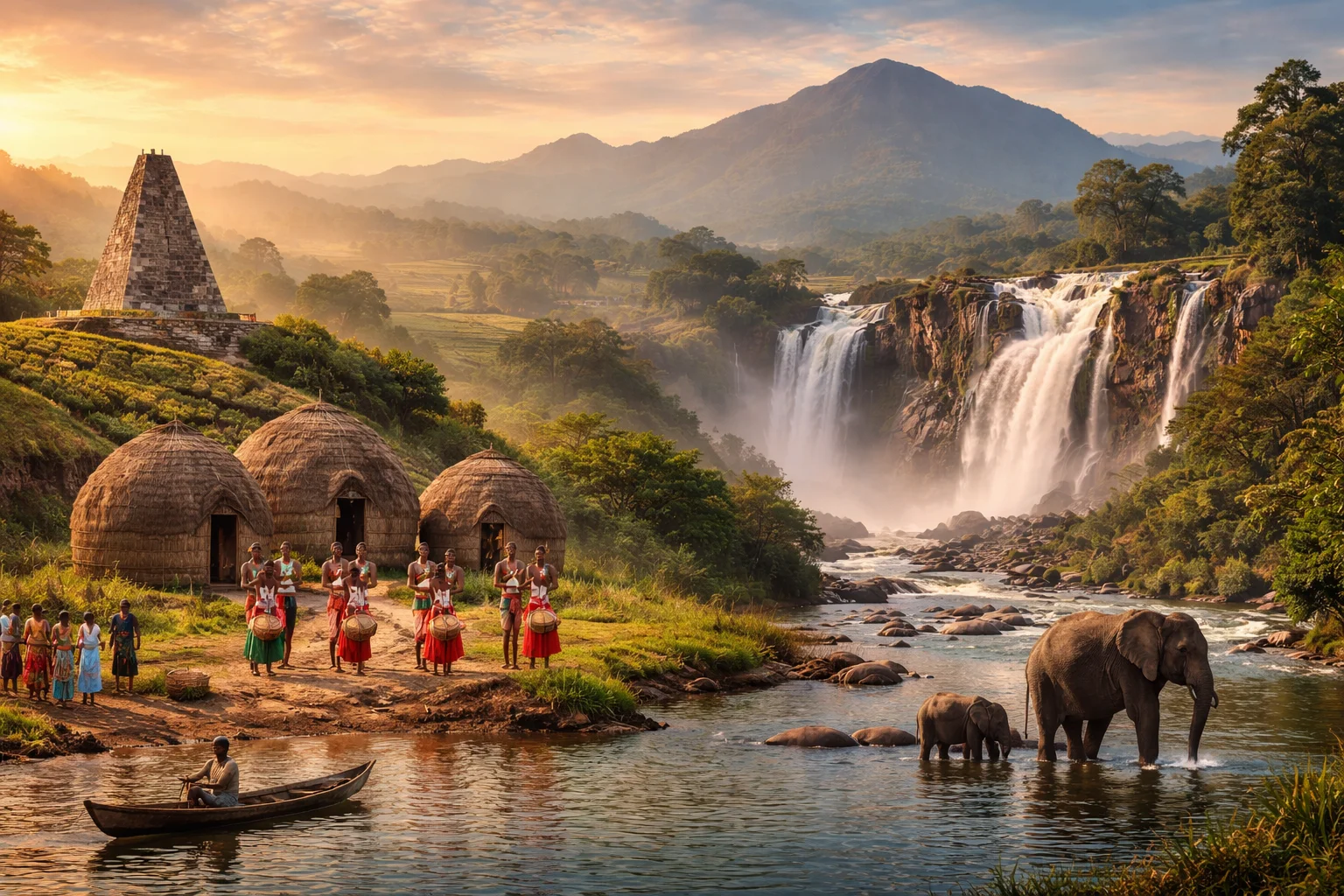
Burundi overview
Burundi is a small, landlocked republic in the African Great Lakes region whose compact territory sits on a high, heavily cultivated plateau. Its significance stems from persistent demographic pressure on limited arable land, a long-standing monolingual national language (Kirundi) that cuts across ethnic lines, and a cultural profile anchored in royal drumming traditions. Geography concentrates settlement on terraced hills; the economy remains agriculture-dominant and export-oriented toward coffee and tea. Readers searching “Burundi geography,” “Burundi culture,” or “Burundi history” will find a country defined by its plateau landscape, dense rural settlement, and distinctive social institutions.
Common Geography Questions About Burundi
Where Burundi is located
Burundi occupies the central-eastern belt of Africa just south of the equator in the African Great Lakes region. It borders Rwanda to the north, Tanzania to the east and south, and the Democratic Republic of the Congo across Lake Tanganyika to the west. Lake Tanganyika’s eastern shoreline forms much of the country’s western limit and drops steeply from the central plateau, giving Bujumbura historical importance as an inland port. Burundi’s location at the meeting point of Congo and Nile drainage basins is a geographic fact that shapes river patterns and watershed identities within the country.
Geography and landscape of Burundi
The physical geography of Burundi is dominated by a central plateau of rolling hills and steep valley escarpments descending toward Lake Tanganyika. Mount Heha, the country’s highest point on the central plateau, punctuates a landscape of terraced farming and erosion-prone soils. Rivers such as tributaries of the Kagera and Ruvubu carve northeastward toward the Nile basin while others drain west into Lake Tanganyika and the Congo system; this dual drainage divide is a distinctive geographic feature. Climatic variation is largely altitudinal—cooler, wetter highlands contrast with warmer lakeshore lowlands—producing regionally varied farming systems uncommon in comparably small states.
Burundi culture and society
Kirundi is the national language spoken across ethnic groups, alongside French and English as official languages; that near-universal use of a single vernacular helps define social cohesion in Burundi. Religious life is predominantly Christian with persistent elements of indigenous belief integrated into community rituals. A singular cultural marker is the royal drumming tradition—the karyenda and associated performance practices—that enjoys UNESCO recognition and plays a ceremonial role in national festivals. Customary institutions such as the Bashingantahe (local elders acting as mediators) remain influential in dispute resolution, a feature that affects local governance and social norms.
History of Burundi
Burundi’s history centers on a pre-colonial centralized kingdom ruled by a mwami (king) and an aristocratic Ganwa class, with continuity of monarchical institutions shaping social hierarchy into the colonial era. German control in the late 19th century passed to Belgian administration after World War I, and Burundi gained independence in 1962. Post-independence decades saw recurring political crises tied to competition between social groups and reforms that transformed royal authority into republican institutions. Peace processes negotiated in the late 20th and early 21st centuries, including power-sharing measures originating from regional mediation, have reshaped state-society relations and Burundi’s role in East African diplomacy.
Burundi economy and government
Burundi is organized as a presidential republic with a legislature that includes a Senate and an elected National Assembly; its constitutional framework incorporates ethnic and regional power‑sharing measures designed after peace negotiations. The economy is heavily agricultural: smallholder production dominates and coffee and tea serve as the primary export crops that generate foreign exchange. The national currency is the Burundian franc. Infrastructure constraints—limited paved road networks and intermittent electricity largely produced by small hydro plants—have constrained industrial diversification, while membership in regional blocs like the East African Community frames trade policy and cross-border economic initiatives.
Regions and major cities of Burundi
Administratively, Burundi is divided into provinces that reflect historic territories and local centers; the government relocated the official political capital to Gitega while Bujumbura remains the largest city and principal commercial port on Lake Tanganyika. Other important urban centers include Ngozi in the north, which serves a highland agricultural hinterland, and Rumonge on the lakeshore, notable for fishing and lakeside trade. Distinct geographic regions—northern highland plateaus, central rolling hills, and the western lakeshore escarpment—correlate with different cropping systems and settlement densities, shaping how major cities function within their respective regional economies.
Distinctive characteristics of Burundi
Burundi is widely associated with a narrow set of concrete features: a national culture of royal drumming with international recognition; headwaters of Nile tributaries arising in its highlands; and a reputation for producing high-quality specialty coffees grown on steep terraces. Its small land area combined with one of Africa’s higher rural population densities creates acute land-use pressure that is frequently cited in development studies. Culturally, the relocation of the political capital to Gitega emphasized preservation of royal archives and museums, reinforcing Burundi’s global profile as a country where cultural heritage and landscape are tightly interwoven.