Bulgaria Guide
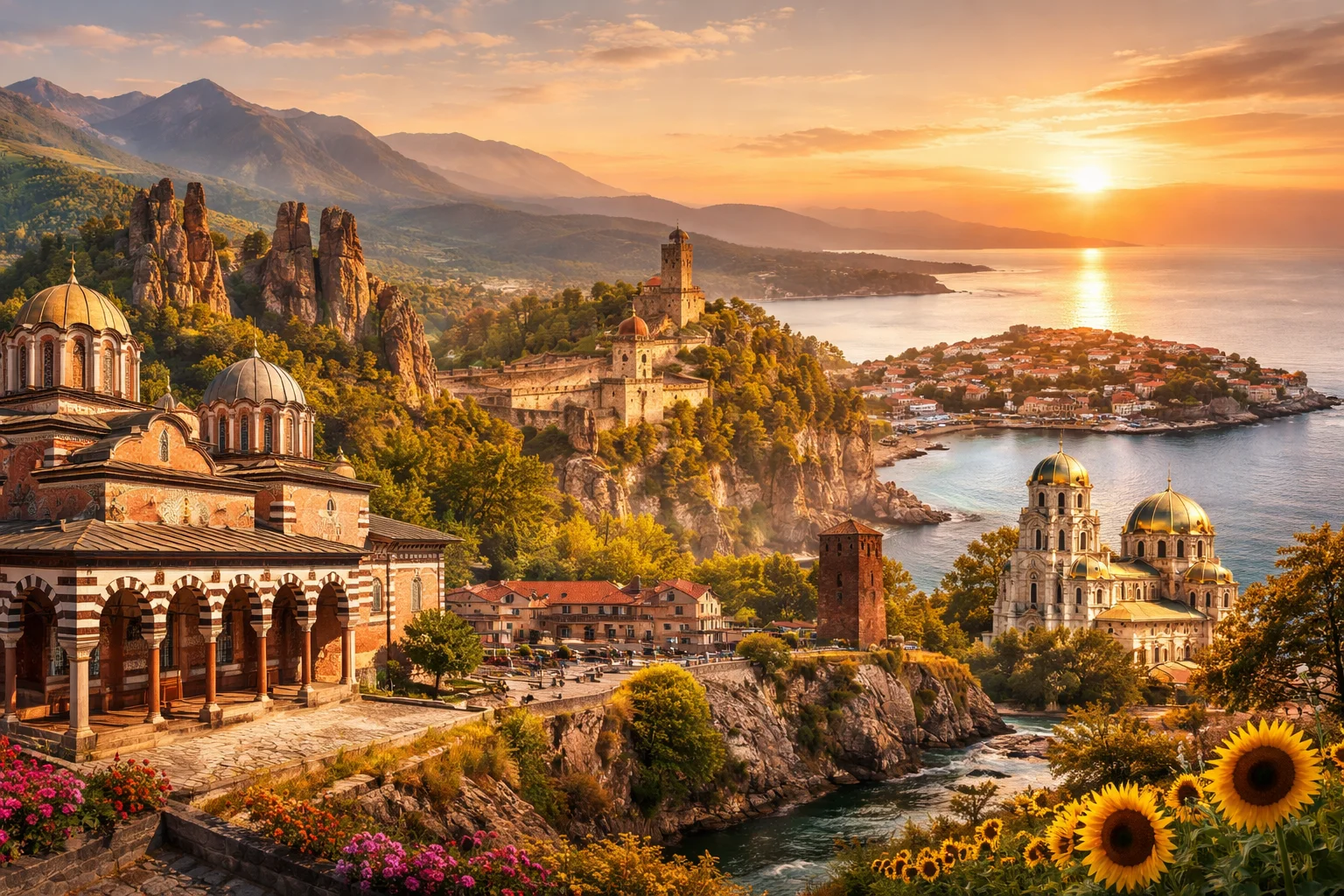
Bulgaria overview
Bulgaria is a country in southeastern Europe with a long cultural lineage and strategic position on the Balkans. Straddling the Danube and the Black Sea, Bulgaria has served historically as a linguistic and commercial crossroads between Europe and Asia. Distinctive facts include being the cradle of the Cyrillic script and the site of the Varna Necropolis, where some of the world’s oldest processed-gold artifacts were found. Contemporary Bulgaria balances agricultural traditions (notably rose oil production) with an expanding services and IT sector.
Common Geography Questions About Bulgaria
Where Bulgaria is located
Bulgaria sits on the eastern part of the Balkan Peninsula in Europe, roughly between 41° and 44° north latitude and 22° and 28° east longitude. It shares land borders with Romania to the north (much of that frontier follows the Danube River), Serbia and North Macedonia to the west, and Greece and Turkey to the south. To the east Bulgaria meets the Black Sea, giving it a significant maritime margin that shapes trade and climate. Its position places the country on a corridor linking Central Europe to Anatolia and the Near East.
Geography and landscape of Bulgaria
Bulgaria’s terrain ranges from the Danubian Plain in the north to the high alpine massifs of Rila and Pirin in the southwest; the Balkan Mountains (Stara Planina) run west–east and traditionally divide the country’s north from its south. Mount Musala in the Rila range is the highest summit in the Balkans. Major rivers include the Danube along the north and the Maritsa cutting through the Thracian Plain; the Black Sea coast features cliffs, sandy bays and the unique Varna and Burgas wetlands. The country’s geography produces continental interiors, Mediterranean-influenced southern valleys and a distinct set of glacial lakes at high elevations.
Bulgaria culture and society
Bulgarian is the official language and uses the Cyrillic alphabet—an alphabetic system that developed in medieval Slavic scholarship associated with the First Bulgarian Empire. Orthodox Christianity is the dominant religion, and ritual customs such as kukeri mask processions and the spring Martenitsa adornment remain widely practiced. Demographically, Bulgaria has experienced population decline and high emigration compared with many neighbors, concentrating urban growth around Sofia. Gastronomy and daily life are marked by products associated specifically with Bulgaria, such as yogurt fostered by the Lactobacillus bulgaricus strain named after the country.
History of Bulgaria
Bulgarian history binds Thracian, Roman and Slavic layers into a distinct medieval polity: after the foundation of the First Bulgarian Empire (7th–11th centuries) the state became a major medieval power that adopted Christianity and supported the creation of the Cyrillic script. Later, the Second Bulgarian Empire briefly restored regional prominence before nearly five centuries of Ottoman rule reshaped social and religious life. The modern Bulgarian state emerged in the late 19th century after the Russo-Turkish conflict and the Treaty of San Stefano (subsequently revised at the Berlin Congress), with full independence declared in 1908 and dramatic 20th-century shifts through monarchy, communist rule and the post-1989 democratic transition.
Bulgaria economy and government
Bulgaria is a parliamentary republic with a unicameral National Assembly of 240 deputies; executive power is exercised by a prime minister and cabinet while the president serves as head of state with limited authority. The economy combines agriculture (notably roses, wheat and wine), energy and mining, and an expanding services sector that includes information technology and outsourcing in urban centers. The national currency is the lev, which operates under a long-standing currency-board arrangement pegged to the euro. As an EU member, Bulgaria participates in European markets while maintaining distinctive economic niches like rose-oil production and competitive software services.
Regions and major cities of Bulgaria
Administratively Bulgaria is divided into 28 provinces (oblasti), each named for its provincial capital—a structure that concentrates regional administration in city-centers rather than historical regions. The capital, Sofia, is the political and economic hub; Plovdiv is the country’s second-largest city and an ancient urban center that served as European Capital of Culture; Varna is the principal Black Sea port and a naval-economic gateway. Cultural regions include the Thracian Plain to the south, the Rhodope mountain area with its own folk music traditions, and the Danubian Plain in the north with different agricultural patterns.
Distinctive characteristics of Bulgaria
Bulgaria is internationally recognized for concrete, traceable achievements: it was central to the creation and spread of the Cyrillic alphabet; the Varna Necropolis produced the earliest known processed-gold artifacts; the Rose Valley around Kazanlak remains a leading source of rose oil used in perfumery worldwide. In science and food culture, the Lactobacillus bulgaricus bacterium links the country to the global yogurt tradition. Contemporary associations include a competitive IT outsourcing sector and a reputation for strong choral and folk music traditions rooted in regionally specific singing styles.
Places in Bulgaria
Kapana
Kapana is a district in Plovdiv, Bulgaria. It sits in the city's central urban core and is formally recognized in Plovdiv municipal planning documents as a distinct cultural and commercial quarter. The district occupies a compact cluster of narrow streets that function as an identifiable planning unit within the municipality. Its significance derives from a sustained role as an artisan and small-business enclave and from municipal heritage initiatives that identify the area for conservation and adaptive reuse.
National Historical Museum
National Historical Museum is Bulgaria's national museum of history and a state cultural institution located in Sofia, Bulgaria. It functions as the principal national repository for historical artifacts and documentary holdings, formally designated to preserve and interpret the country’s material past. The museum occupies a multi-hall complex that serves as exhibition space, conservation workshops, and archival repository under national institutional status, and it is responsible for curating the primary state collection of Bulgarian historical objects.
Rila Monastery
Rila Monastery is the largest Eastern Orthodox monastery in Bulgaria, located in a mountain valley of the Rila range. It functions as an active monastic community and as a major repository of Bulgarian religious art and manuscripts. The complex comprises a medieval defensive tower, a central church with extensive painted decoration, and a compact ensemble that together form a clearly defined monument of national architectural significance.
Sofia
Sofia is the capital city of Bulgaria and the country's largest urban center by population. It serves as the principal political, economic, and cultural hub. Sofia has a population exceeding 1.2 million within municipal boundaries, a concrete indicator of its urban scale. The city functions as a central node for national transportation networks and for major higher education institutions. The municipality covers approximately 492 square kilometers, defining its formal spatial extent.
Sofia University
Sofia University is a public research university in Bulgaria. Founded in 1888 and formally named Sofia University "St. Kliment Ohridski", it is the oldest institution of higher learning established within the modern Bulgarian state and serves as a national flagship for tertiary education. The university operates multiple faculties and research units across an urban campus in central Sofia and maintains long-standing academic collections, including an institutional library and a university botanical garden. As a state university, Sofia University participates in national higher-education governance and publishes peer-reviewed research across the humanities, natural sciences, and social sciences.
Sofia Zoo
Sofia Zoo is a zoological garden in Bulgaria located in the city of Sofia and serves as the capital's principal public zoo. The site functions as an organized scientific collection with formal enclosures, permanent animal holdings, and institutional responsibilities for ex-situ conservation within the municipal framework. Its recognized role as the city’s main zoological institution defines the zoo’s public mandate, collection profile, and relationship to municipal parks administration.