Bhutan Guide
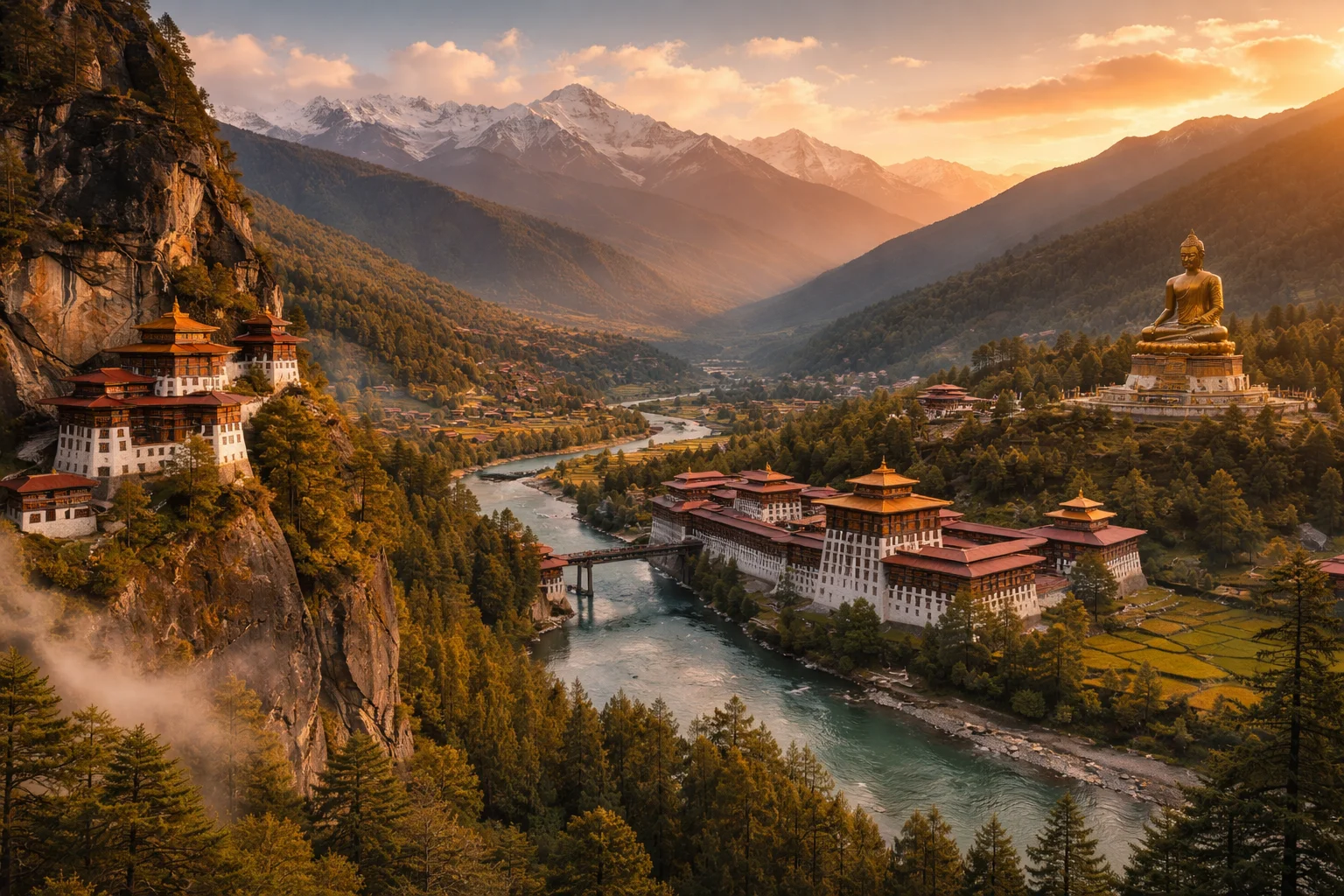
Bhutan overview
Bhutan is a small, landlocked kingdom in the eastern Himalaya known for linking statecraft to national well-being. Occupying a narrow arc of high mountains and deep valleys, Bhutan combines a constitutional monarchy with explicit development goals that prioritize Gross National Happiness over simple GDP growth. Its national identity is closely tied to Tibetan-Buddhist institutions, fortress-monasteries called dzongs, and constitutional protections that require a minimum forest cover. This introduction frames Bhutan as a country where governance, ecology, and cultural continuity are legally intertwined rather than separate policy arenas.
Common Geography Questions About Bhutan
Where Bhutan is located
Bhutan sits in South Asia on the eastern edge of the Himalayan range, roughly between 26°N–28°N latitude and 88°E–92°E longitude. It is landlocked, bordered to the south, east and west by India and to the north by the Tibet Autonomous Region of China. No part of Bhutan touches the ocean; instead its hydrology feeds southward into the Brahmaputra River basin via tributary systems such as the Wang Chhu and Drangme Chhu. The kingdom’s location along the southern slopes of the Himalaya creates a strategic corridor between the Tibetan plateau and the Indian subcontinent, shaping both its climate and historical trade routes.
Geography and landscape of Bhutan
Bhutan’s geography is a steep altitudinal gradient from subtropical valleys at about 100–300 meters (southern foothills) to alpine highlands above 4,000 meters; most of the country is rugged Himalayan terrain. The main mountain ranges are southern lesser Himalaya ridges and the higher Great Himalaya in the north; several peaks exceed 7,000 meters. Bhutan’s river system—led by the Amo/House (Torsa), Wang Chhu, and Manas tributaries—cuts narrow valleys used for settlement and hydroelectric projects. Distinctive to Bhutan is a constitutional mandate preserving at least 60% tree cover, which makes forested watersheds central to national land-use planning and biodiversity conservation strategies.
Bhutan culture and society
Bhutan’s culture is rooted in Vajrayana Buddhism, which functions as a public religion and a framework for social norms; state rituals and daily life are often organized around monastic calendars. Dzong architecture—fortress-monasteries that combine administrative and religious functions—remains a living institutional form unique in scale and continuity. Languages include Dzongkha as the national language, with a mosaic of languages such as Sharchhop and various Tibetan-Burmese dialects across regions. Social customs include the driglam namzha code, which prescribes national dress and formal etiquette in government and monasteries; this formal cultural regulation distinguishes Bhutan’s approach to preserving visible cultural markers.
History of Bhutan
Bhutanese history centers on the 17th-century consolidation under the Zhabdrung Ngawang Namgyal, who fused spiritual and temporal authority through the dzong system, creating a polity distinct from neighboring Himalayan states. For centuries Bhutan managed limited contact with British India, preserving internal structures while engaging selectively in trade and border diplomacy. In the 20th century a hereditary monarchy unified modern administration, then transitioned intentionally toward parliamentary democracy in the early 21st century with a written constitution. Bhutan’s historical arc is notable for deliberate isolation and selective modernization that kept monastic-administrative institutions central longer than in most neighboring states.
Bhutan economy and government
Bhutan is a constitutional monarchy with an elected parliament and a king who retains symbolic and reserve powers; political reforms in the 2000s deliberately devolved executive authority into party-based legislative governance. The economy blends state-led planning, hydropower exports to India, and regulated tourism policies that enforce a minimum daily tariff for visitors. Agriculture remains a major livelihood source in terraced valleys, while hydropower and niche exports—such as organic agricultural branding tied to national forest policy—drive fiscal strategy. The ngultrum is the currency, pegged informally to the Indian rupee, reflecting a monetary linkage that shapes trade and fiscal policy.
Regions and major cities of Bhutan
Administratively, Bhutan is divided into 20 dzongkhags (districts) that reflect historic dzong jurisdictions rather than purely demographic logic; these administrative units concentrate civil and monastic authority in district towns. The capital, Thimphu, is distinct for being the only national capital in the world without traffic lights until the early 21st century and remains the political and cultural hub. Other major cities include Phuentsholing—an industrial and border trade gateway to India—and Paro, notable for its international airport situated in a mountainous valley. Regional differences map closely to elevation: southern districts host subtropical agriculture, central valleys concentrate administration, and northern highlands remain sparsely populated.
Distinctive characteristics of Bhutan
Bhutan is globally associated with Gross National Happiness as a policy philosophy that explicitly measures progress beyond GDP, and with legally enshrined environmental protections that aim for at least 60% forest cover and carbon-negative status. The country’s dzongs, the National Day celebrations, and its cautious, high-value tourism model are widely cited as distinctive administrative-cultural blends. Bhutan’s hydropower exports to India and its strategic position between China and India make it a frequent subject in regional security and development studies, while conservation success stories—such as contiguous protected-area systems linking national parks—give it a recognizably conservation-centered international profile.