Benin Guide
Benin overview
Benin is a small West African republic on the Gulf of Guinea, officially the Republic of Benin. Straddling a narrow latitudinal corridor between Togo and Nigeria, it is best known for the historical Kingdom of Dahomey, the contemporary cultural prominence of Vodun, and the economic role of the Port of Cotonou. Benin’s political life mixes a constitutional capital (Porto-Novo) with government functions concentrated in its largest city, a layout that shapes national administration and commerce. Its compact size belies marked regional contrasts in landscape and society.
Common Geography Questions About Benin
Where Benin is located
Benin sits in West Africa, approximately between 6°N and 12.5°N latitude and roughly 0.8°E to 3.9°E longitude, forming a north–south strip on the Gulf of Guinea. It borders Togo to the west, Nigeria to the east, and Burkina Faso and Niger to the north. The southern edge opens onto the Bight of Benin, giving the country a short Atlantic coastline; Lake Nokoué and the city of Cotonou lie on a coastal lagoon. Benin’s slender geography—wider north-to-south than east-to-west—creates a pronounced climatic and ecological gradient within a compact territory.
Geography and landscape of Benin
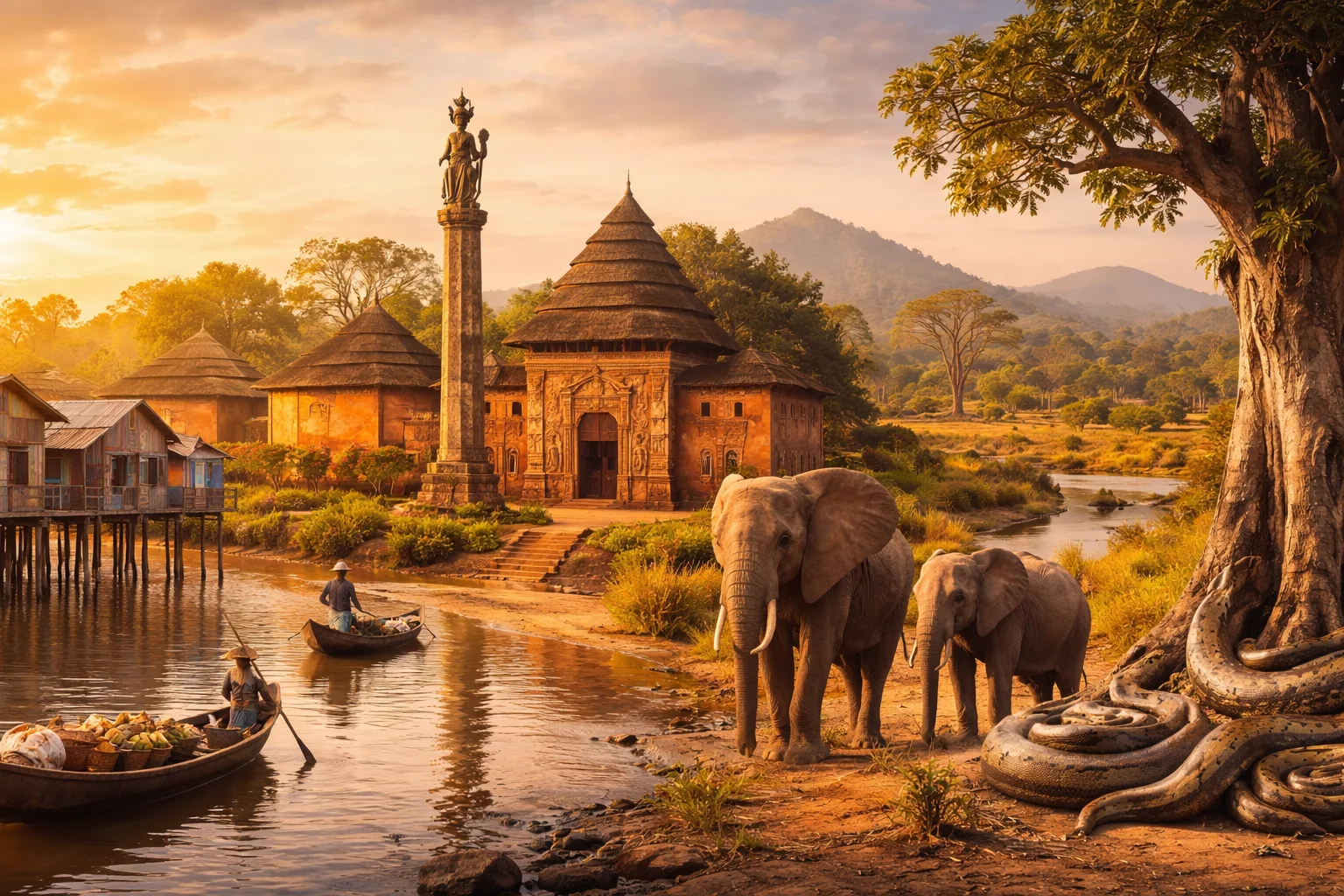
Benin’s terrain ranges from low, marshy coastal plains and the lake-studded lagoon near Cotonou to the rolling plateaus of central Benin and the Atakora mountain chain in the northwest. Mont Sokbaro, often cited as the country’s highest point, rises from the Atakora range and frames a savannah that transitions into the Pendjari basin—part of the larger W-Arly-Pendjari transboundary conservation complex. The Ouémé River is the main watercourse flowing to the coast; in the south, human-built villages like Ganvié occupy Lake Nokoué on stilts, a unique adaptation to the lagoon environment that distinguishes Benin’s coastal geography from regional neighbors.
Benin culture and society
French is Benin’s official language, but the population speaks dozens of autochthonous languages—Fon, Adja, Yoruba, and Bariba among the most prominent—each anchoring distinct social networks. The country is widely regarded as the birthplace of Vodun (voodoo), with a national Vodun festival in Ouidah and public shrines embedded in everyday life; this religious syncretism coexists with Christianity and Islam. Benin’s society is multiethnic and largely rural outside urban corridors; matrilineal and patrimonial customs coexist regionally, and cultural markers such as Dahomey appliqué textiles and public royal palaces remain living elements of identity.
History of Benin
Benin’s recorded past centers on powerful precolonial states, most notably the Kingdom of Dahomey, which consolidated state power through centralized institutions and a famed female military corps often called the Dahomey Amazons. Coastal towns like Ouidah became nodes in the transatlantic slave trade, linking the region to the Americas and shaping diasporic cultural flows. French colonization integrated the territory into French West Africa; independence came in 1960, followed by decades of political experimentation including a Marxist-Leninist phase under Mathieu Kérékou and a transition back to multiparty democracy around 1990. Abomey’s royal palaces now testify to the kingdom’s regional legacy.
Benin economy and government
Benin is a unitary republic with a presidential system under a written constitution; multiparty elections have governed national leadership since the democratic transition in the early 1990s. Porto-Novo is the constitutional capital, while Cotonou functions as the economic and administrative hub—a dual-city arrangement uncommon among neighboring states. The economy centers on agriculture (cotton historically the leading export), port-led trade and re-exports through Cotonou, and growing cashew and palm oil sectors; the country uses the West African CFA franc (XOF), linked to the regional central bank (BCEAO), which shapes fiscal and monetary dynamics.
Regions and major cities of Benin
Administratively, Benin is divided into twelve departments—reconfigured from six in 1999 to improve local governance—subdivided into communes. Porto-Novo is the official capital; Cotonou is the largest city and principal port; Parakou serves as a commercial hub in the north. Other notable urban centers include Abomey, the historical seat of Dahomey’s royalty, and Ouidah, a coastal town central to religious pilgrimages and the slave-trade heritage. Geographic regions—coastal lagoon, central plateau, and northern savannah/mountain zone—correspond to distinct economic patterns and cultural identities across the departments.
Distinctive characteristics of Benin
Benin is internationally associated with specific cultural and heritage features: it is widely considered the birthplace of Vodun, hosts the Route of Slaves sites in Ouidah, and preserves the Royal Palaces of Abomey as a UNESCO World Heritage site. Ecologically, the Pendjari National Park is one of West Africa’s last intact savannah ecosystems with notable elephant and lion populations. Economically, Cotonou’s port serves as a regional re-export center for landlocked neighbors, a role that has made Benin a logistics gateway in francophone West Africa. These concrete legacies give Benin a recognizable profile beyond its size.