Barbados Guide
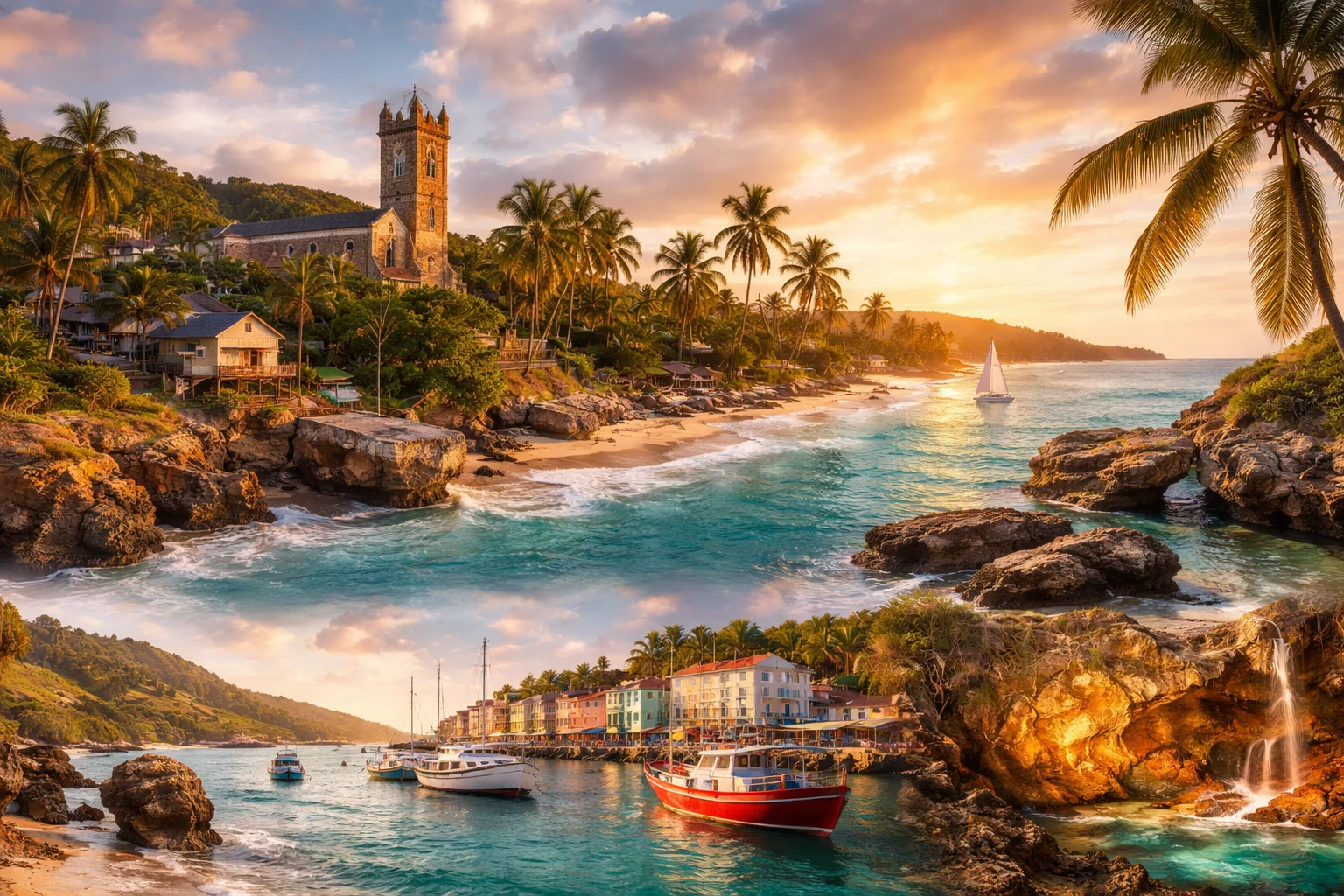
Barbados overview
Barbados is a sovereign island country in the Lesser Antilles of the Caribbean, defined by its coral limestone base and long engagement with Atlantic and Caribbean maritime routes. Located east of most Caribbean islands, Barbados combines a compact land area (about 430 km²) with dense settlement patterns, a service-oriented economy, and an outsized cultural influence regionally. The island is notable for its English-language legal and parliamentary traditions inherited from colonial rule, a distinctive Crop Over festival rooted in the sugar economy, and a UNESCO-designated historic center in its capital.
Common Geography Questions About Barbados
Where Barbados is located
Barbados lies in the North Atlantic, on the eastern edge of the Caribbean region, roughly at 13.1°N latitude and 59.6°W longitude. It has no land borders; nearest sovereign neighbors across sea lanes are Saint Vincent and the Grenadines and Grenada to the west-southwest, while Trinidad lies further to the south. The island sits between the Atlantic Ocean to the east and the Caribbean Sea to the west, and because it is the easternmost island in the Caribbean chain it receives direct Atlantic swells—an important geographic fact that differentiates Barbados from most other Caribbean islands and shapes its coastal character.
Geography and landscape of Barbados
Barbados’s geography is dominated by a gently sloping coral limestone plateau interrupted by a small central highland called the Scotland District in the northeast, where uplifted marine sediments and clay soils produce steeper terrain and erosion-prone gullies. The island’s highest point, Mount Hillaby, reaches about 340 meters—unusual for a coral island in the region. Rivers are ephemeral; drainage is through gullies and underground aquifers rather than large perennial rivers. Coastal fringing reefs and a narrow shelf protect much of the west coast, while the east coast is raw Atlantic shoreline—this distinct west-versus-east coastal dichotomy is central to Barbadian land use and coastal management.
Barbados culture and society
English is the official language in Barbados, while Bajan — a distinct English-based creole — functions as the everyday vernacular and marks social identity. Christianity, particularly Anglican and evangelical denominations, is widespread; however, public life preserves elements from African heritage, such as tuk band music and masquerade traditions. Crop Over, a summer harvest festival revived from slave-era sugar plantations, is culturally central and culminates in a nationally broadcast parade. Demographically, Barbados is a compact, densely populated society with an outsized diaspora; its social institutions reflect long-established parish-based community networks rather than provincial administration common elsewhere.
History of Barbados
Barbados was inhabited by Amerindian peoples before European contact, then settled permanently by the English in the early 17th century and rapidly transformed into a plantation colony based on sugar and enslaved African labor. The island’s 17th-century Slave Codes and intensive sugar monoculture exerted influence across the British Caribbean. Post-emancipation social structures evolved around smallholder agriculture and merchant classes linked to British trade. Independence from the United Kingdom in 1966 marked political autonomy; later constitutional developments culminated in replacing the monarchy with a parliamentary republic, a change reflecting a long arc from colonial plantation economy to an independent, service-oriented state.
Barbados economy and government
Barbados operates a parliamentary system modeled on Westminster practices, with a bicameral parliament and a head of state drawn from a republican presidency rather than a monarch; local political life remains organized around parish constituencies. The economy shifted from sugar dominance to services: tourism, international business and finance, education (regional university campus), and rum exports are primary earners. The Barbadian dollar (BBD) has for decades been officially pegged to the U.S. dollar, a specific monetary arrangement that stabilizes trade pricing. Agricultural land use has contracted, leaving a notable policy focus on diversifying into knowledge services and niche agro-products.
Regions and major cities of Barbados
Administratively, Barbados is divided into eleven parishes—an ecclesiastical legacy still used for local identity and land records—rather than provinces or states. Bridgetown, in the parish of Saint Michael, is the capital and primary port; its Historic Bridgetown and Garrison area holds UNESCO World Heritage status. Other notable population centers include Holetown and Speightstown on the west coast and Oistins in the south, a fishing town famed for its fish fry culture. The island’s internal geography is often framed as the west coast (sheltered, tourism-oriented) versus the east coast (Atlantic-exposed, more rugged), a distinction more granular than broad regional labels.
Distinctive characteristics of Barbados
Barbados is globally associated with several concrete signifiers: its national dish of flying fish and cou-cou, the Crop Over festival that draws Caribbean-wide attention, and a long cricketing legacy that produced internationally renowned players and a fervent local cricket culture. Bridgetown’s UNESCO site and the island’s historical Slave Code records connect Barbados to broader imperial and Atlantic histories. The island’s notable offshore financial services sector and a widely recognized cultural export—global pop star Rihanna, born in Bridgetown—also link this small nation to international cultural and economic networks in ways few comparably sized countries achieve.