Azerbaijan Guide
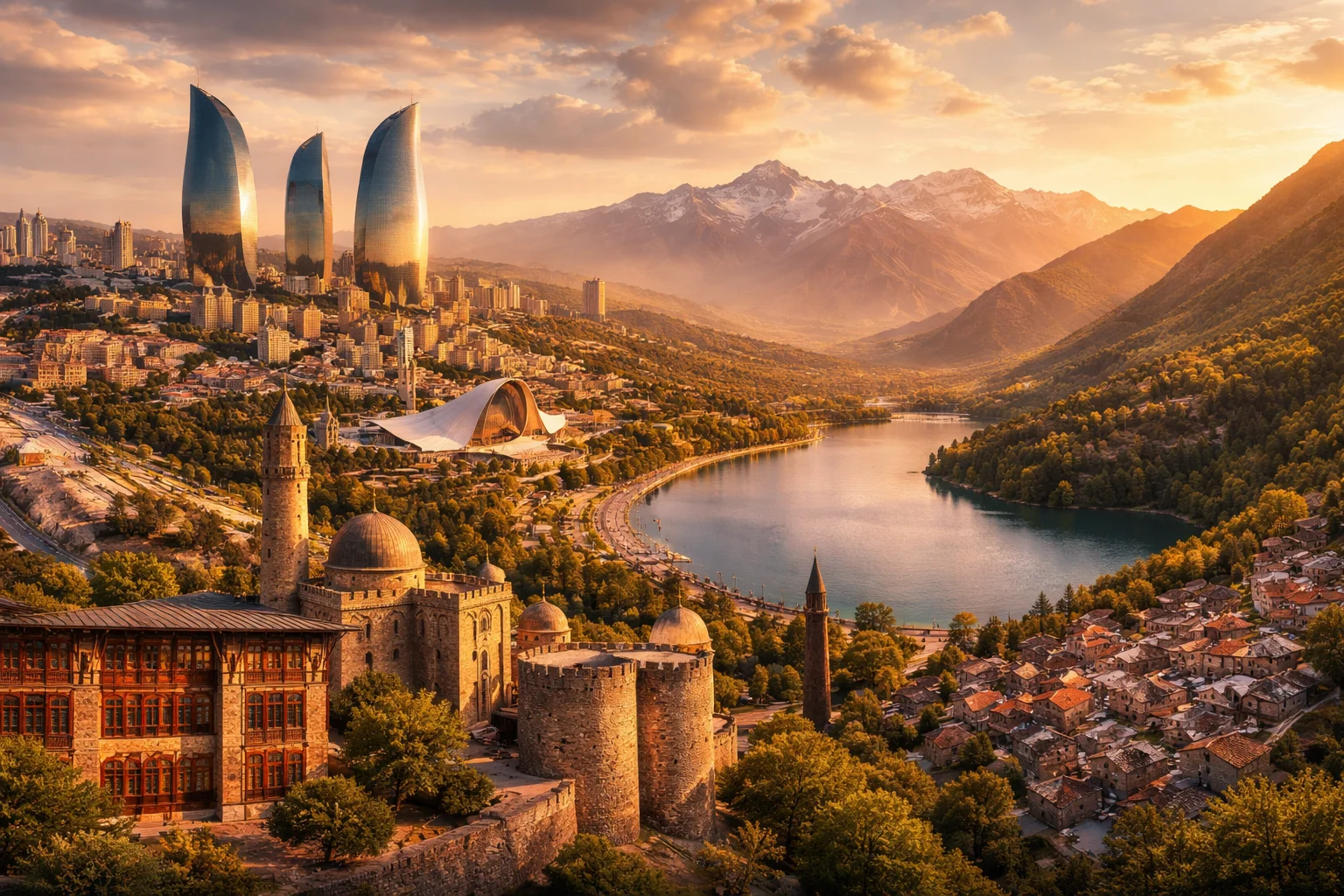
Azerbaijan overview
Azerbaijan is a country in the South Caucasus that links the Eurasian steppe, the Caucasus mountains and the Caspian littoral. It combines a centuries‑old role as an oil-producing hub with a distinctive Turkic language and a majority Shia Muslim population administered under a secular state framework. The republic includes an isolated exclave, Nakhchivan, separated from the mainland by foreign territory, and sits astride energy transit corridors that have shaped its regional significance. This compact mix of geology, energy infrastructure and cultural fusion defines Azerbaijan’s modern profile.
Common Geography Questions About Azerbaijan
Where Azerbaijan is located
Azerbaijan lies at the boundary of Eastern Europe and Western Asia in the South Caucasus, roughly between 38° and 42° north latitude and 44° and 50° east longitude. It borders Russia to the north, Georgia to the northwest, Armenia to the west and Iran to the south; the Nakhchivan exclave also shares a short border with Turkey. The country’s eastern flank faces the landlocked Caspian Sea, which defines its coastline and offshore continental shelf. Those maritime and trans‑Caspian connections are part of what locates Azerbaijan as a geographic pivot between Black Sea and Central Asian routes.
Geography and landscape of Azerbaijan
Azerbaijan’s terrain ranges from the Greater Caucasus peaks in the north—where Mount Bazarduzu rises as the country’s highest point—to the low-lying Kura-Aras plain that drains toward the Caspian Sea. The Lesser Caucasus and Talysh Mountains frame the southwest, while the Absheron Peninsula projects into the Caspian around Baku. The Kura River is the principal watercourse. Unusually for its size, Azerbaijan contains highly localized climate zones—from alpine tundra to semi-desert—and a notable concentration of mud volcanoes and geothermal manifestations concentrated on and off the Absheron Peninsula, a geological signature rarely so compact in a single state.
Azerbaijan culture and society
Azerbaijan’s primary language is Azerbaijani (a Turkic tongue), written in Latin script after transitions through Arabic and Cyrillic alphabets; sizable minority languages include Russian, Lezgian and Talysh. The population is predominantly Shia Muslim, yet secular civic institutions and Soviet legacies shape public life; Nowruz spring festivals, ashug troubadour poetry and a living mugham tradition are social staples. Carpet weaving and regional food customs (such as layered plov variations tied to local rice strains) remain embedded in family and regional identity, producing cultural markers that differ noticeably between the Caspian coast, the highlands and the Talysh lowlands.
History of Azerbaijan
Azerbaijan’s history moves from ancient Caucasian Albania and Persian imperial rule to successive Turkic migrations and Safavid-era incorporation; the territory repeatedly served as a frontier between empires. The late 19th‑century Baku oil boom transformed local society and attracted international capital, including the Nobel brothers, creating an industrialized urban core. In 1918 the Democratic Republic of Azerbaijan proclaimed a secular, parliamentary state; after Sovietization in 1920 it became a constituent Soviet republic until restoring independence in 1991. Twentieth-century territorial disputes over Nagorno-Karabakh have been central turning points that reshaped population distributions and national policy.
Azerbaijan economy and government
Azerbaijan is a presidential republic with a unicameral legislature (Milli Majlis) and an autonomous Nakhchivan entity that maintains its own constitution and assembly. Economically, hydrocarbons dominate: offshore and onshore oil and gas fields, the State Oil Company (SOCAR) and the State Oil Fund (SOFAZ) anchor state budgets and export strategies. Key infrastructure—such as the Azeri-Chirag-Gunashli fields and major pipelines running westward from Baku—illustrates the country’s role in regional energy flows. The national currency is the Azerbaijani manat; authorities have pursued diversification into agriculture, textiles and information technologies alongside sustained energy investment.
Regions and major cities of Azerbaijan
Administratively Azerbaijan is divided into multiple rayons (districts), cities and the autonomous Nakhchivan Republic; regional identities are often defined by geography—Caspian coastal Shirvan, the Greater Caucasus highlands, the western lowlands and Talysh-Mugan subtropical zones. The capital, Baku, sits on the Absheron Peninsula and combines a UNESCO-listed Old City with modern high-rise architecture built atop historic oil fields. Other major cities include Ganja, known for its carpets and historical architecture, and Sheki, famed for the Sheki Khan’s Palace with its traditional shebeke stained-glass windows. These urban centers serve distinct economic and cultural roles within the country.
Distinctive characteristics of Azerbaijan
Azerbaijan is widely associated with a handful of concrete, internationally recognized features: its historic role in global oil production during the Baku boom and the Nobel investment era; UNESCO-recognized practices such as mugham music and carpet weaving; and visible natural phenomena like Yanar Dag (flames issuing from natural gas seeps) and concentrated mud-volcanism on the Absheron shelf. On the contemporary stage the country is linked to pan-regional energy corridors originating in Baku and to cultural exports—carpets, mugham recordings and a distinctive culinary repertoire—that have made Azerbaijan a recognizable presence in global cultural and energy discussions.
Places in Azerbaijan
Baku
Baku is the capital and largest city of Azerbaijan. It is located in eastern Azerbaijan, on the western shore of the Caspian Sea. The city functions as the nation's principal political, economic, and cultural centre and encompasses an administrative area of approximately 2,130 square kilometres. Baku's significance arises from its long history as an oil-producing region, its strategic coastal location for regional maritime links, and a built environment that includes medieval fortifications alongside modern architectural features and civic institutions.
Baku City Circuit
Baku City Circuit is a temporary street circuit in Azerbaijan used as a venue for Formula One motorsport events. The circuit occupies public roads in central Baku and is formally designated as a temporary F1 street circuit, incorporating a long waterfront straight along the Caspian Sea and a narrow section that passes adjacent to Baku’s medieval walled Old City; it therefore combines urban street pavement with temporary racing infrastructure as its defining physical fact.
Baku Old City
Baku Old City is the historic walled core of Baku, Azerbaijan, forming the medieval center of the modern capital. It is significant for its dense urban fabric, surviving fortifications, and ensemble of monuments that illustrate regional history. The historic nucleus covers roughly 22.5 hectares and contains nationally important monuments such as palace complexes and defensive towers. The site functions as a primary reference for the architectural and urban history of the Absheron Peninsula.
Baku State University
Baku State University is a public university in the Republic of Azerbaijan and one of the country’s principal higher-education institutions. It was established in 1919 by a decree of the Parliament of the Azerbaijan Democratic Republic, a formal founding fact that anchors its institutional identity. The university functions as a state-run research and teaching institution, with an organized campus in central Baku, a defined governing relationship to national education authorities, and a long record of producing academic staff and graduates for Azerbaijan’s public, scientific, and cultural sectors.
Baku Zoo
Baku Zoo is the principal zoological institution of Azerbaijan. Located in the capital city of Baku, it functions as the country’s main state-curated urban zoo and public scientific collection. The site contains purpose-built enclosures, an administrative compound, and quarantine facilities that support long-term animal care and husbandry. Baku Zoo serves an institutional role in captive management, species interpretation, and municipal natural-history display within Azerbaijan’s network of cultural and scientific facilities.
Flame Towers
Flame Towers is a trio of flame-shaped skyscrapers in Baku, Azerbaijan, that form a prominent modern landmark. The complex includes three towers with a maximum height of about 190 meters and accommodates hotel, office, and residential functions. Its programmable exterior lighting and glazed facades make it a visible element of the city's built identity. The development represents a quantifiable change to Baku's skyline by adding one of the tallest contemporary structures in the urban core.
Gobustan National Park
Gobustan National Park is a state-protected cultural and geological landscape in the Republic of Azerbaijan. The park covers approximately 537 hectares of rocky outcrops and surrounding terrain, and it is notable for extensive prehistoric rock art and active mud volcanoes. Gobustan National Park is significant as both an archaeological archive and a geological laboratory, preserving tangible evidence of long-term human occupation and dynamic earth-surface processes. The site includes open-air petroglyph ensembles and geological formations that have been the subject of systematic study.
Gobustan Petroglyphs
Gobustan Petroglyphs is a collection of prehistoric rock carvings and archaeological features located in Azerbaijan, recognized for its exceptional cultural value. The site comprises engraved stone panels produced by successive human communities and illustrates long-term human activity on a rocky plateau. It contains over six thousand individual rock images and was inscribed as a World Heritage property in 2007, making it a formally documented reference point for studies of prehistoric art and human-environment interaction.
Heydar Aliyev Center
Heydar Aliyev Center is a museum and cultural complex in Azerbaijan named for the country's former leader Heydar Aliyev. It is located in the capital city, serving as a national cultural institution that houses exhibition galleries and multipurpose public halls. The building was designed by Zaha Hadid Architects and is formally identified as a museum and cultural center in Azerbaijani cultural planning documents. Its program combines permanent and temporary exhibition spaces with conference and education facilities.
Khinalug Village
Khinalug Village is a high-mountain settlement in the Greater Caucasus of northeastern Azerbaijan that preserves distinctive cultural and linguistic traits. The community is notable for its continuous habitation and for preserving a locally distinct Northeast Caucasian language. Researchers reference the settlement for studies of vernacular architecture and mountain adaptation. The site sits at roughly 2,350 metres above sea level, a measurable geographic characteristic used routinely in official descriptions.
Lake Goygol
Lake Goygol is a mountain lake in western Azerbaijan noted for its clear blue water and protected landscape. The lake lies at about 1,556 metres above sea level and occupies a basin formed by a large landslide and valley blockage. Lake Goygol is the central natural feature of a wider conservation area and provides a measurable example of a post-earthquake natural dam lake studied for geomorphology and freshwater ecology. Its size and elevation make it a distinct highland lacustrine system in the Lesser Caucasus.
Mud Volcanoes
Mud Volcanoes is an assemblage of eruptive mud cones, pools and flows located in Azerbaijan, notable for geological and hydrocarbon significance. Azerbaijan contains about 350 mud volcanoes, representing one of the world's largest concentrations of such features. The site illustrates active geologic processes that produce mud extrusions, gas emissions, and occasional flame events where hydrocarbons ignite. Scientific study of Mud Volcanoes informs regional and global models of sedimentary overpressure, fluid migration, and petroleum systems.