Austria Guide
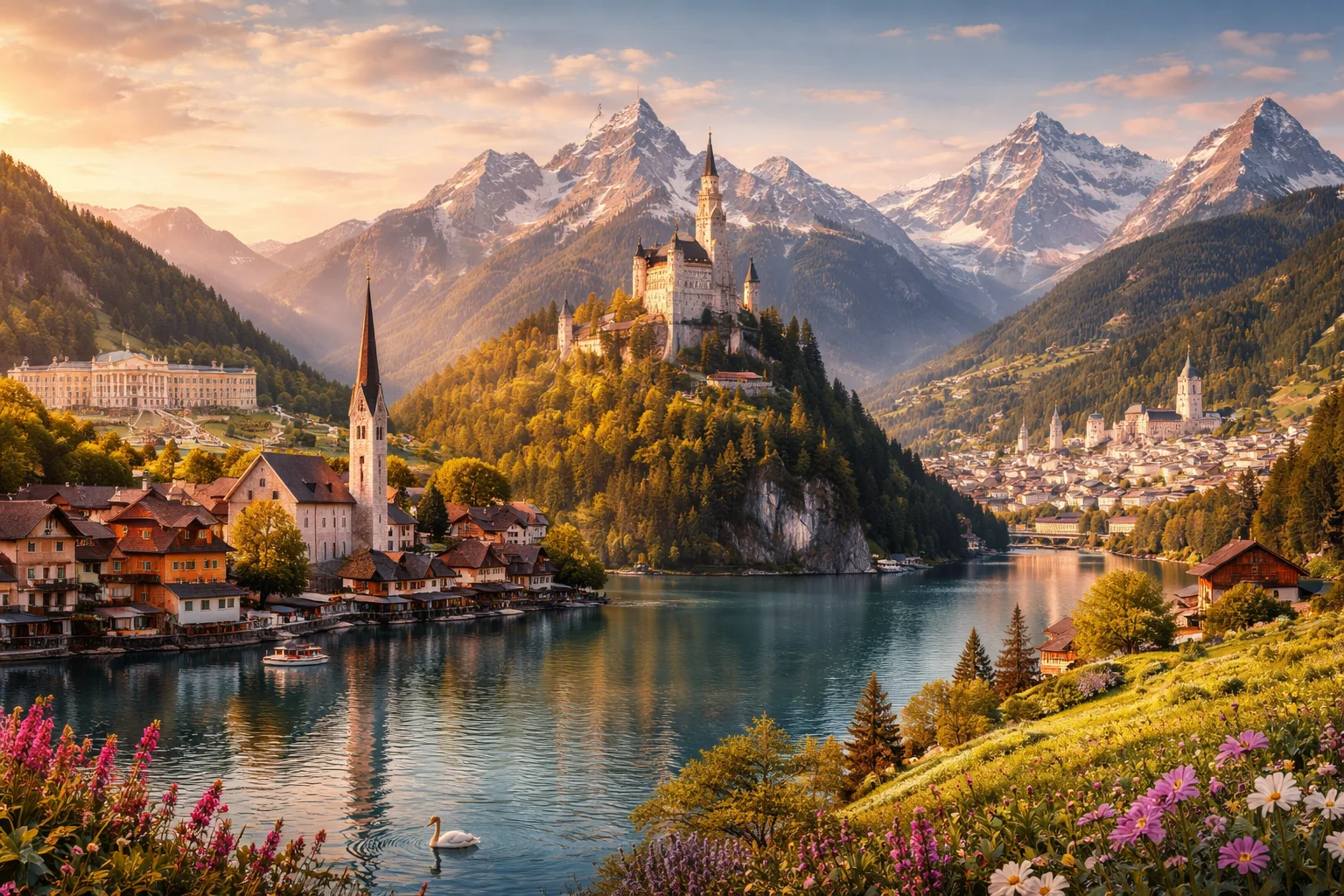
Austria overview
Austria is a landlocked federal republic in Central Europe centered on the Eastern Alps. Straddling an alpine spine and an eastern lowland, the country has been a historical crossroads between Germanic, Slavic and Romance-speaking regions and served as the core of the Habsburg monarchy. Its significance lies in a concentrated cultural legacy—classical music, imperial architecture and Vienna’s coffee-house tradition—and a modern economy that combines precision manufacturing, alpine tourism and Vienna’s role as a diplomatic hub. This combination of high mountains and urban cultural institutions distinguishes Austria from most neighboring states.
Common Geography Questions About Austria
Where Austria is located
Austria sits in Central Europe between roughly 46° and 49° north latitude and 9° to 17° east longitude, occupying a corridor between Western and Eastern Europe. It borders eight countries: Germany and the Czech Republic to the north, Slovakia and Hungary to the east, Slovenia and Italy to the south, and Switzerland and Liechtenstein to the west; this eight-neighbor configuration is unusually high for a country of its size. The Danube River slices across Austria’s northeast, and the Pannonian plain edges into the Burgenland region; together these features anchor Austria’s geography and transport routes.
Geography and landscape of Austria
The Alps dominate Austria’s landscape: high ranges such as the Hohe Tauern—whose Grossglockner peak reaches 3,798 meters—define much of the western and central terrain, while the eastern fringe opens into the Pannonian basin. Rivers include the Danube, Inn and Salzach; the Danube valley creates a navigable east–west corridor uncommon in purely alpine countries. Climatically Austria has alpine, continental and Pannonian influences, producing glacier-fed valleys in Tyrol and a steppe-like microclimate near Lake Neusiedl in Burgenland. Seasonal alpine pasturing (alms and transhumance) remains a living land-use pattern unique to the country’s rural economy.
Austria culture and society
German is the official language, spoken in regional Austrian German variants; the state also recognizes autochthonous Slovene, Croatian and Hungarian language communities in border states, a legal multilinguality not present in every small European country. Austria’s social customs include the Vienna coffee-house as a long-standing public sphere (inscribed as intangible heritage), the long ball season in Vienna and the Heuriger wine-tavern tradition around grape-growing districts. Religion has historically been Roman Catholic with regional variations, and demographic trends show urban concentration around Vienna contrasted with long-established rural alpine communities.
History of Austria
Austria’s territory was part of Roman Noricum before medieval duchies coalesced under the Babenbergs and later the rise of the Habsburgs, who made Vienna a dynastic and administrative center. Over centuries the Habsburg lands expanded into a multi-ethnic empire with Austria as its core; that imperial role shaped European diplomacy and culture. The collapse of that empire after World War I, the interwar republic, Anschluss with Germany, postwar occupation and the 20th-century reestablishment of an independent, neutral republic are defining turns. Austria’s historical imprint is particularly visible in Central European state formation and cultural institutions originating in Habsburg Vienna.
Austria economy and government
Austria is a federal parliamentary republic divided into nine states (Bundesländer), with a largely ceremonial Federal President and an executive Chancellor who leads government formed in the Nationalrat (parliament). Constitutional neutrality, affirmed after World War II, is a distinctive political posture that shaped Austria’s international role. The economy mixes advanced manufacturing—steel, machinery and automotive suppliers—high-value services concentrated in Vienna, and a tourism sector centered on alpine skiing and spas; these sectors together create a mixed industrial-service profile. The national currency is the euro, and Vienna hosts major international organizations, reinforcing Austria’s economic and diplomatic linkages.
Regions and major cities of Austria
Administratively Austria comprises nine states including the city-state of Vienna, Lower Austria, Upper Austria, Styria, Tyrol, Salzburg, Carinthia, Vorarlberg and Burgenland; the political map reflects historic duchies and mountain boundaries. The capital city and state is Vienna (capital city) — a distinct municipal-state model — while other major cities are Graz, Linz and Salzburg, each a regional center with specialized industries or cultural roles. Geographically the country splits into the alpine west (Tyrol, Vorarlberg), the central highlands and the Danube corridor, and the Pannonian-influenced east around Burgenland and Lower Austria.
Distinctive characteristics of Austria
Austria’s global profile rests on concrete, nameable contributions: composers Mozart and Haydn with origins in Salzburg and Austria’s Habsburg musical courts; the Semmering Railway as an early mountain railway engineering landmark; Vienna as a longstanding diplomatic hub with UN offices; Sigmund Freud’s development of psychoanalysis in Vienna; and the inscription of Vienna’s coffee-house culture on UNESCO lists. The country’s alpine infrastructure and winter-sports industry, combined with a concentrated imperial architectural heritage—Schönbrunn and Hofburg palaces—produce a set of associations that are specifically Austrian rather than interchangeable with other small European states.
Places in Austria
Albertina
Albertina is a museum in Austria located in the central district of Vienna. Situated on the Ringstraße in the Innere Stadt, it occupies a former Habsburg palace and holds a principal collection of works on paper assembled from the holdings of Duke Albert of Saxe-Teschen. The institution presents both long-term displays from its graphic arts holdings and rotating exhibitions that reflect its curatorial role in Austria’s cultural infrastructure.
Alpenzoo Innsbruck
Alpenzoo Innsbruck is a zoological facility in Innsbruck, Austria specializing in species of the Alpine biogeographic region. It is located on the lower slopes of the Nordkette mountain range above the urban core and maintains a curated live collection focused on mountain fauna and associated habitats. The institution is formally organized as a regional scientific collection with an explicit remit to conserve, research, and exhibit animals representative of the Alps and adjacent central European mountains.
Belvedere Museum
Belvedere Museum is a national art museum complex in Austria centred on a Baroque palace ensemble in the city of Vienna. The institution occupies two primary palaces—the Upper and Lower Belvedere—linked by a formal terraced garden, and it is notable for housing significant holdings of Austrian painting, including an important group of works by Gustav Klimt. The museum functions as a state-level gallery that combines historic palace fabric with a permanent collection and rotating exhibitions.
Eisriesenwelt Cave
Eisriesenwelt Cave is a karst show cave in Austria, noted for extensive natural ice formations within its limestone chambers. Its primary location is within the municipality of Werfen in the Austrian state of Salzburg, a formally defined administrative fact that anchors its geographic identity. The cave’s significance derives from the persistent presence of ice-speleothems in a mid-alpine karst setting and from its documented development as a mapped and managed subterranean feature.
Hallstatt
Hallstatt is a small lakeside village and municipality in Austria's Salzkammergut region, recognized for its prehistoric salt mining and archaeological importance. It occupies a narrow strip between Hallstätter See and steep alpine cliffs, giving it a distinctive lakeshore setting. The settlement stands at about 511 metres elevation and the municipal territory covers roughly sixty square kilometres. Hallstatt's significance derives from its preserved industrial remains, funerary assemblages, and inclusion within a designated cultural landscape of international heritage value.
Hallstatt-Dachstein
Hallstatt-Dachstein is a cultural and natural landscape in Austria centered on the lakeside town of Hallstatt and the Dachstein massif. It is notable for a long history of salt extraction, a compact lakeshore settlement, and dramatic limestone topography. The area includes the Hoher Dachstein summit at 2,995 meters above sea level, a concrete measured elevation that highlights the site’s altitudinal range and contributes to its international significance and formal recognition.
Krimml Waterfalls
Krimml Waterfalls is a multi-tiered waterfall in Austria located on the Krimmler Ache stream. It has a total vertical drop of about 380 metres and lies within the alpine landscape of the Hohe Tauern massif, giving it measurable vertical relief and a distinct three-tiered form. Krimml Waterfalls is significant for its pronounced vertical profile, persistent spray zone, and role within regional hydrology and conservation frameworks.
Kunsthistorisches Museum
Kunsthistorisches Museum is a museum in Austria located in the capital city of Vienna. It stands on the Ringstraße at Maria-Theresien-Platz and was established to house and present the art collections assembled by the Habsburg imperial court. The institution occupies a purpose-built palatial building designed as a public museum with galleries, a central dome, and a grand staircase. The building faces an identically scaled natural history counterpart across a formal plaza.
Leopold Museum
Leopold Museum is a museum in Austria located in Vienna that centers on Austrian modern and early twentieth-century art. It is situated within the MuseumsQuartier cultural precinct in Vienna’s Neubau district and houses a major collection that includes important works by Egon Schiele and Gustav Klimt, providing a formal institutional repository for Viennese modernism and a measurable public collection assembled from a private foundation. This designation defines its primary significance in Austria’s art landscape.
Red Bull Ring
Red Bull Ring is a Formula One circuit in Austria. It is located at approximately 47.2197°N, 14.7644°E and uses a 4.318-kilometre lap layout on its principal configuration. The Red Bull Ring occupies a compact footprint with a pit complex, paddock buildings and grandstands that together accommodate six-figure event capacities. The circuit’s significance stems from its layered motorsport identity, measurable lap length, and corporate patronage under Red Bull that anchors its contemporary profile.
Salzburg
Salzburg is a city in Austria on the northern edge of the Alps, notable for its dense historic centre and cultural output. It functions as a regional economic and administrative hub and ranks as the fourth-largest city in Austria by population. The compact urban core includes preserved streets, public squares, and ecclesiastical precincts that together represent measurable heritage value in architecture, music history, and municipal administration.
Salzburg Zoo
Salzburg Zoo is a zoological garden in Austria. It occupies a hillside setting adjacent to Hellbrunn Palace in the city of Salzburg and is commonly known locally as Tiergarten Hellbrunn. The institution functions as a curated zoological collection within the cultural landscape of Hellbrunn, with enclosures arranged to follow steep terrain and to integrate with the palace's historic park. The zoo's formal identity as a named city-area zoological garden is central to its role in regional animal husbandry and public education.