Antigua and Barbuda Guide
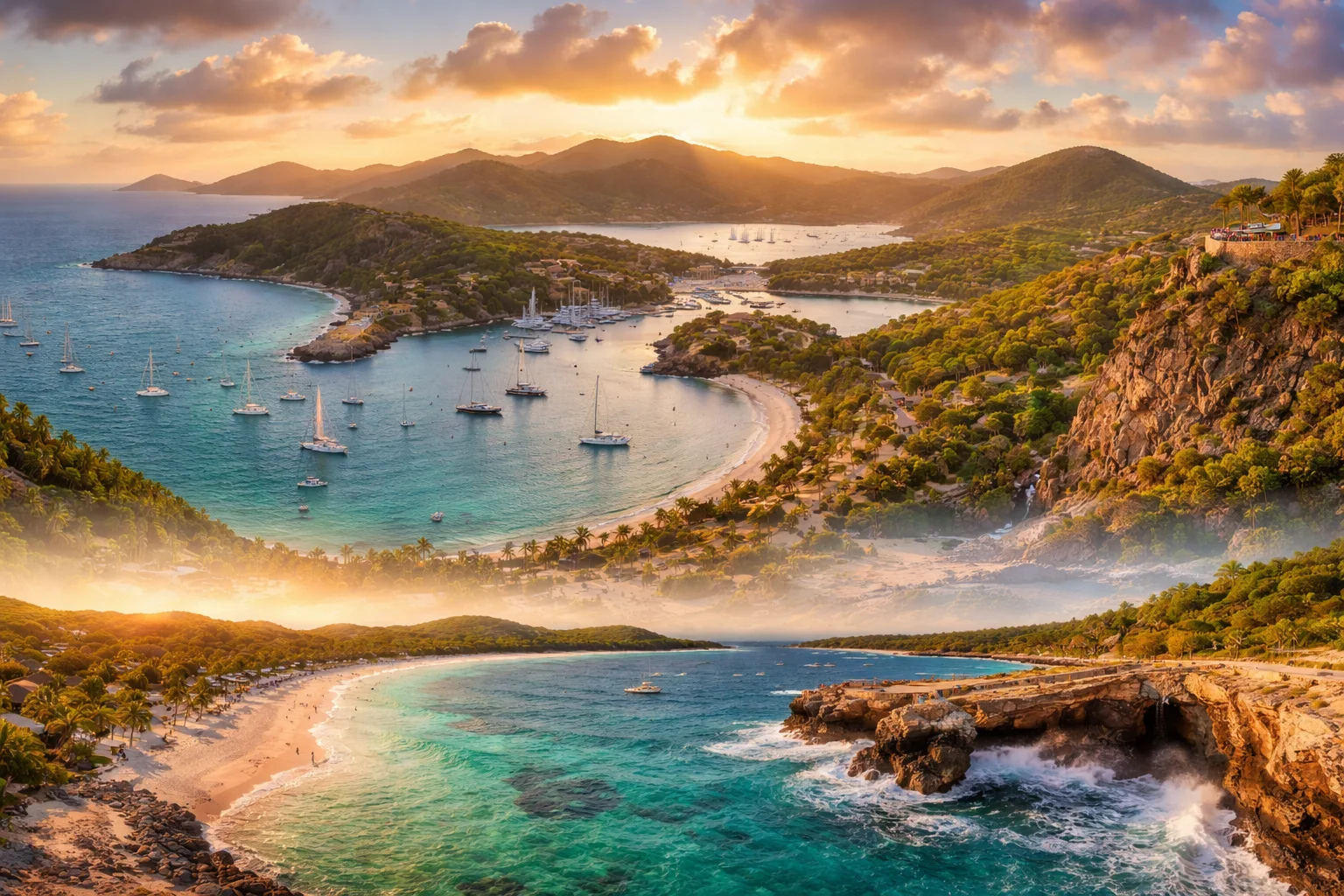
Antigua and Barbuda overview
Antigua and Barbuda is a sovereign twin-island state in the eastern Caribbean composed primarily of Antigua, Barbuda, and the small uninhabited islet Redonda. The country’s significance stems from a long maritime history—Antigua’s English Harbour once served as a major British naval base—and from a modern economy built on tourism, yachting and offshore services. The islands combine a low, coral-limestone Barbuda with a more volcanic Antigua whose highest point was officially renamed Mount Obama. The national profile is shaped by dense coastal development on Antigua, a tiny, tight-knit population on Barbuda, and unusually strong local land-rights traditions on Barbuda.
Common Geography Questions About Antigua and Barbuda
Where Antigua and Barbuda is located
Antigua and Barbuda sits in the northeastern Leeward Islands of the Lesser Antilles in the Caribbean Sea and on the edge of the Atlantic Ocean, roughly around 17.1° N latitude and 61.8° W longitude. Nearest sovereign neighbors include Saint Kitts and Nevis to the northwest and Guadeloupe to the south; Montserrat lies to the west and is a British Overseas Territory. The archipelago occupies a narrow maritime corridor where Atlantic swell meets Caribbean trade-wind seas—Antigua’s east coast is Atlantic-facing while the west coast borders calmer Caribbean waters—defining its maritime climate and reef exposure.
Geography and landscape of Antigua and Barbuda
The geography of Antigua and Barbuda contrasts a gently undulating, volcanic- and limestone-based Antigua with a flat, coral-limestone Barbuda and a sheer, rocky Redonda. Antigua’s terrain includes low ridges and gullies rather than extensive mountain ranges; its highest summit, Mount Obama, reaches just over 400 meters. Barbuda’s defining landscape is Codrington Lagoon and broad fringing reefs, supporting the island’s large seabird colonies. Notably, Antigua has no permanent rivers—drainage runs in seasonal “guts”—so freshwater availability depends on underground aquifers, rainfall capture and limited desalination, shaping settlement and agriculture patterns.
Antigua and Barbuda culture and society
English is the official language in Antigua and Barbuda, overlaid by an Afro-Caribbean English creole in everyday speech; Barbuda preserves dialect and family networks distinct from Antigua’s urban centers. Christianity predominates, with Anglican and Pentecostal traditions prominent, while African-derived festivals and music inform public life. Two distinctive social features are the scale of Antigua’s boating and regatta culture—anchoring an international yachting community—and Barbuda’s communal land tenure under the Barbuda Council, which treats much of the island as collective land rather than private plots. Population is heavily concentrated on Antigua; Barbuda remains sparsely settled around Codrington village.
History of Antigua and Barbuda
Antigua and Barbuda’s history moves from Arawak and later Carib habitation through European contact—Columbus sighted Antigua in 1493—to British colonization in the 17th century. Antigua developed a plantation economy built on enslaved African labor and sugar production; meanwhile Barbuda’s history included a long proprietary tenure under the Codrington family, leaving a legacy of communal land use. English Harbour became a strategic Royal Navy base in the 18th century, influencing regional power. The islands transitioned from colonial dependency to internal self-government and ultimately to full sovereignty in the late 20th century, repositioning their economy from agriculture toward services and tourism.
Antigua and Barbuda economy and government
Antigua and Barbuda is a constitutional monarchy and parliamentary democracy within the Commonwealth: the monarch is the ceremonial head of state, represented locally by a Governor-General, while executive power rests with a Prime Minister and Cabinet accountable to an elected House of Representatives; a Senate provides appointed review. Economically, the country is service-oriented—tourism, marine services and international financial services dominate—supplemented by small-scale agriculture and construction. The national currency is the Eastern Caribbean dollar (XCD), issued by the Eastern Caribbean Central Bank. A distinctive economic instrument is the government’s long-standing citizenship-by-investment program, which channels foreign capital into development projects.
Regions and major cities of Antigua and Barbuda
Administratively, Antigua is divided into parishes while Barbuda is treated as a dependency with its own Barbuda Council; the tiny island of Redonda is uninhabited and administered as part of the state. The capital and primary urban center is St. John’s on Antigua, the hub of government, commerce and port activity. Other notable places include Codrington, the sole significant settlement on Barbuda, and English Harbour on Antigua, known for its restored colonial dockyard and marina facilities. These centers reflect geographic splits: Antigua hosts most of the population and infrastructure, while Barbuda remains rural, low-lying and ecologically distinct.
Distinctive characteristics of Antigua and Barbuda
Antigua and Barbuda is globally associated with a few specific, verifiable features: Nelson’s Dockyard and English Harbour’s 18th-century naval legacy; Antigua Sailing Week and a pronounced international yachting reputation; Barbuda’s Codrington Lagoon and its large frigatebird nesting colony; and Mount Obama’s renaming, a rare national toponymic tribute. Culturally, the nation produced world-class cricket talents—most famously Sir Vivian Richards—linking it to global sport. The micronational and literary curiosity of Redonda also gives the country a unique cultural footnote that has attracted writers and collectors beyond the Caribbean.