Andorra Guide
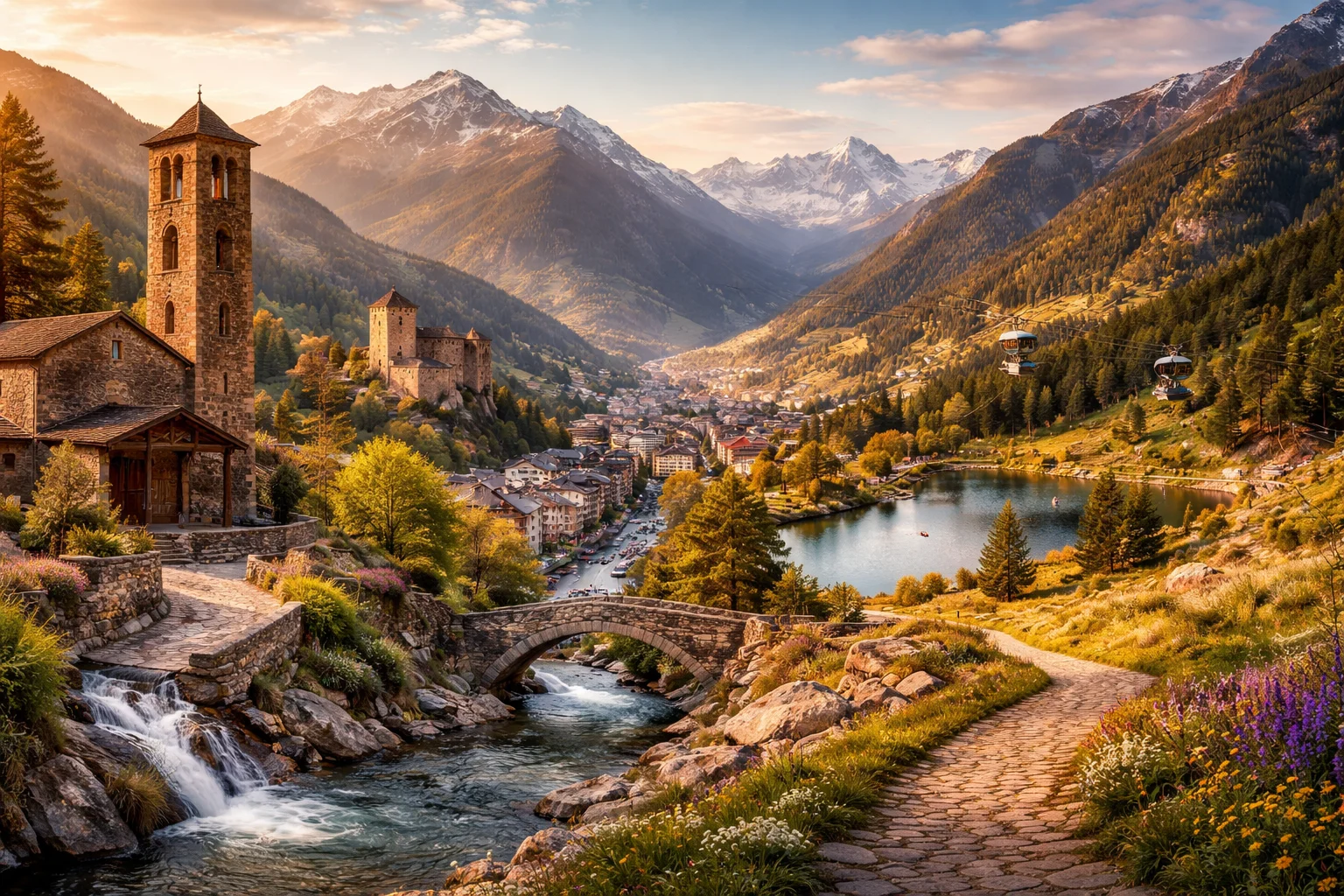
Andorra overview
Andorra is a sovereign microstate in the eastern Pyrenees defined by a medieval co-principality origin and a modern parliamentary constitution. Nestled between Spain and France, Andorra combines high-mountain geography with a service-oriented economy centered on tourism and retail. Its official language is Catalan, making it the only country with Catalan as the sole state language. Andorra’s small territory and historic autonomy have produced distinct legal and fiscal arrangements that shaped its regional significance beyond what its population size might suggest.
Common Geography Questions About Andorra
Where Andorra is located
Andorra sits in southwestern Europe, in the island-like mountain arc of the Pyrenees roughly between 42°30′N and 1°30′E. Bordered only by France to the north and Spain to the south and west, Andorra has no coastline and no land border with any other state. The principality occupies roughly 468 square kilometres of watershed that drains mainly toward the Segre via the Gran and Valira river systems. Its location astride traditional trans-Pyrenean routes concentrates transport through a few mountain passes rather than broad plains or riverine corridors.
Geography and landscape of Andorra
The geography of Andorra is overwhelmingly alpine: steep valleys, glacial cirques and rocky ridges dominate, with the highest summit, Coma Pedrosa, rising to 2,942 metres. The principal river network is formed by the Valira and its tributaries, confined to narrow, terraced valleys that limit arable land. Climatically, Andorra exhibits mountain microclimates—cold, snowy winters at high elevation and more temperate conditions in sheltered valleys—rather than uniform lowland weather. Distinct regions include northern highlands with pastures and southern slopes that open toward Catalonia, a contrast sharper than in many small states.
Andorra culture and society
Andorra’s culture is anchored by Catalan, the principality’s sole official language, a distinction unique among sovereign states. Social life blends Pyrenean mountain traditions with Iberian and Occitan influences: patronal festivals tied to Catholic feast days coexist with alpine folk music and a strong outdoor-sports culture. The resident population has a high proportion of foreign-born inhabitants relative to its size, producing multilingual everyday life—Catalan, Spanish, Portuguese and French are commonly heard. Community identity is reinforced by parish-based institutions and local patronal festivities that retain medieval organizational patterns.
History of Andorra
Andorra’s historical identity formed through negotiated dual lordship rather than complete annexation: a 13th-century paréage established joint rule that evolved into the modern arrangement. For centuries it functioned as a feudal buffer between Catalonia and Occitania, sheltering local autonomy through negotiated privileges rather than centralized state-building. The late 20th-century adoption of a written constitution transformed Andorra into a parliamentary democracy while preserving unique sovereignty arrangements rooted in medieval precedent. That continuity—from feudal paréage to constitutional microstate—marks Andorra’s unusual path in European history.
Andorra economy and government
Andorra’s political system is a parliamentary democracy organized around the unicameral General Council; daily governance resembles other European parliaments but is layered over historic sovereignty forms. Economically, services dominate: tourism (especially alpine skiing), retail trade driven by lower indirect taxation, and financial services are principal sectors. The country uses the euro through an international agreement and issues its own euro coins with national motifs, despite not being an EU member—an uncommon monetary arrangement. Past banking secrecy practices shaped the economy’s development, though regulatory and transparency reforms have reoriented financial activity.
Regions and major cities of Andorra
Administratively, Andorra is divided into seven parishes (parròquies) that trace medieval ecclesiastical boundaries—an enduring local governance form not typical elsewhere. The capital, Andorra la Vella, sits in a high valley and functions as the commercial and administrative core; Escaldes-Engordany and Encamp are other notable population centres. Geographic subregions range from the northern pastoral highlands (Ordino, La Massana) to the southern entry corridor at Sant Julià de Lòria. Major cities are small by international standards but concentrate services, skiing access and cross-border commerce.
Distinctive characteristics of Andorra
Andorra is globally recognized for a small set of concrete features: its status as the only sovereign state with Catalan as the sole official language; major ski domains such as Grandvalira and Vallnord that anchor a tourism-driven economy; and the minting of national designs on euro coins despite non-membership in the EU. It also lacks a domestic international airport, relying instead on mountain passes and nearby foreign airports—an infrastructural peculiarity for a European country. These tangible traits give Andorra a recognizable profile in sport, retail and numismatic circles.